WebSocket Debugging: Handshake, Proxies, Heartbeats, Reconnects
WebSocket debugging is reliable when you separate six boundaries: the HTTP opening handshake, the open transport, application messages, liveness detection, the close sequence, and.

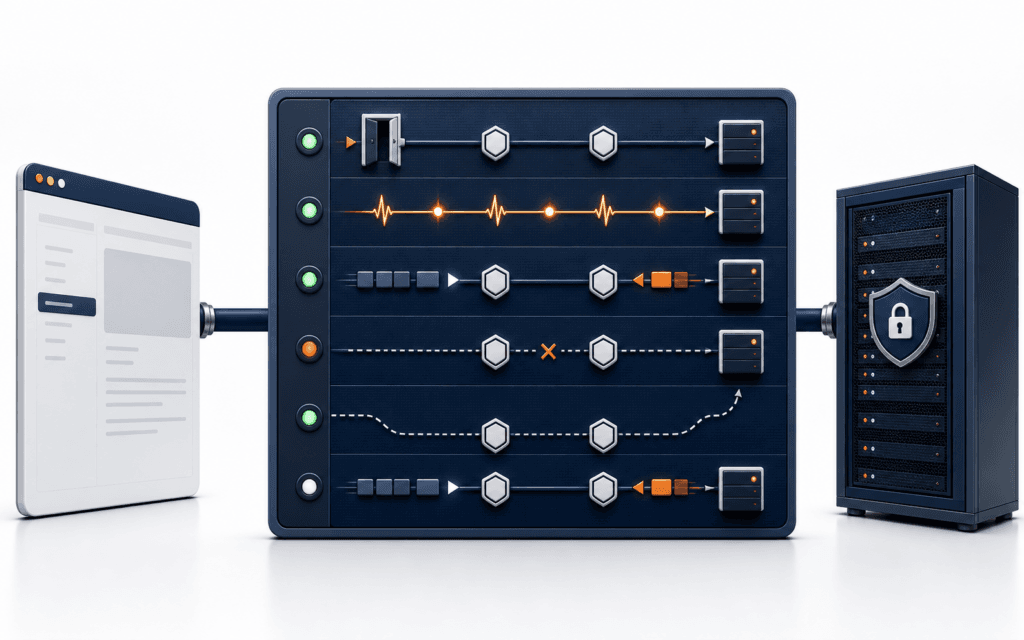
WebSocket debugging is reliable when you separate six boundaries: the HTTP opening handshake, the open transport, application messages, liveness detection, the close sequence, and state restoration after reconnect. Capture evidence at the boundary that failed before changing proxy timeouts, heartbeat intervals, or retry loops.
Use approved test accounts and redact authorization data, cookies, query tokens, message payloads, personal data, internal hosts, and full close reasons. Status codes, timestamps, frame direction, message type, sequence identifiers, connection IDs, and yes-or-no delivery results are usually enough to diagnose the fault.
Classify The Lifecycle Failure
Begin with one reproducible symptom and assign it to a lifecycle stage. A connection that never reaches open is a handshake problem. A connection that opens and immediately closes is a policy, authentication, subprotocol, or server problem. A quiet connection that stops delivering is a liveness problem. Duplicate or missing state after recovery is an application protocol problem.
Record page URL, WebSocket URL, browser version, environment, network type, proxy path, connection start time, readyState transitions, open event, last sent and received message times, close event fields, and server correlation ID. This timeline prevents a reconnect symptom from being mistaken for the original fault.
Capture The Opening Handshake
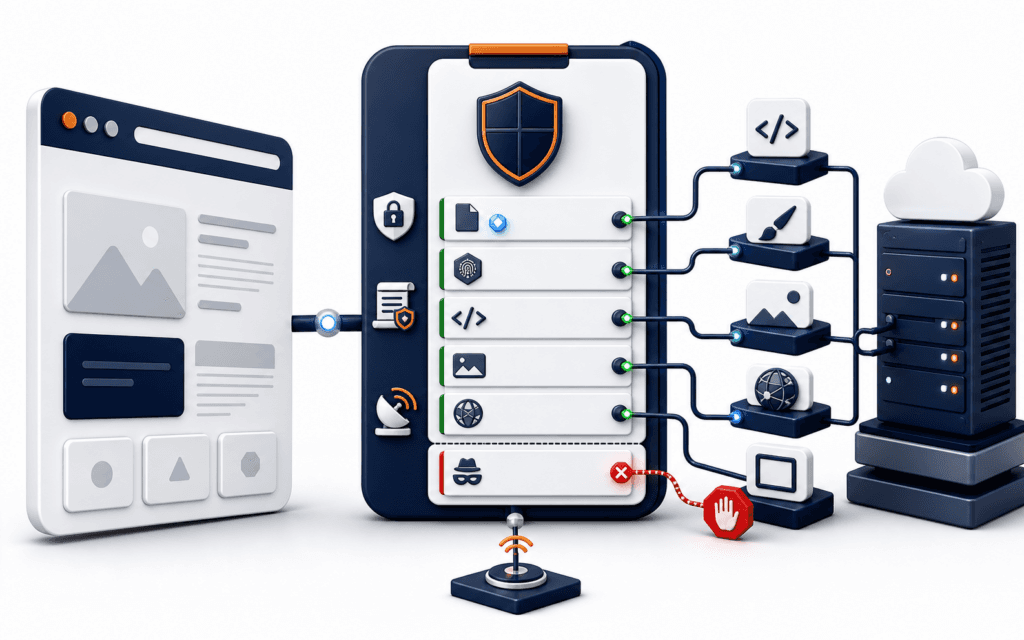
Inspect the WebSocket request in browser Network tools. Preserve the request URL, method, response status, request and response headers, timing, redirect behavior, selected subprotocol, and any visible failure text. The RFC 6455 opening handshake begins as an HTTP request and must complete before WebSocket frames can flow.
Do not troubleshoot frames until the response proves the upgrade completed. A normal HTTP 200 page, authentication redirect, 403 policy response, 404 route, 426 version response, gateway error, or TLS failure belongs to the HTTP path. Fix that path before adding application retries.
Verify URL TLS Origin And Authentication
Confirm the client uses the intended ws or wss scheme, host, port, and path. Public production pages should normally use wss so browser security and intermediaries see an encrypted connection. Verify the certificate chain, hostname, clock, and any redirect before the upgrade request.
Browser WebSocket constructors do not expose arbitrary request-header control. Authentication may rely on cookies, a short-lived URL token, a negotiated subprotocol, or an application message after open. Document the chosen model and its leakage risks. Pair cookie-based cases with the HTTP cookie debugging workflow.
Check Upgrade Headers And Status
For an HTTP/1.1 upgrade, verify the client request carries the expected Upgrade, Connection, Sec-WebSocket-Key, and Sec-WebSocket-Version fields and the server returns the protocol-defined switching response with matching acceptance data. Let the browser generate handshake fields rather than fabricating them in application code.
If a gateway removes connection-specific headers or routes the path to an ordinary HTTP handler, the server never sees a valid upgrade. Compare the public-edge request with an approved direct-origin test. Do not bypass authentication, TLS, or the proxy in production merely because a direct test works.
Validate Subprotocols And Extensions
If the client offers WebSocket subprotocols, record the ordered list and the single value selected by the server. The WHATWG WebSockets standard requires the negotiated result to match what was offered. A server that selects an unexpected value can cause the browser to fail the connection.
Treat subprotocol names as application contracts, not authorization secrets. Verify version compatibility, message schema, and rollout order. Also inspect extension negotiation, such as compression, on both ends. Disable an extension only in a controlled comparison and confirm memory, CPU, and message behavior before changing production defaults.
Trace Reverse Proxies And Timeouts
Map every hop: browser, CDN, load balancer, gateway, reverse proxy, service mesh, and application server. For each, verify WebSocket support, upgrade forwarding, idle timeout, maximum connection age, request timeout, buffering behavior, and graceful deployment handling. Use documented settings for the actual products and versions.
A connection can upgrade successfully and still be closed by an idle intermediary. Compare disconnect timing with configured limits and infrastructure logs. If many clients close at the same interval, investigate the shared hop before changing client reconnect code. Heartbeats must occur often enough for the narrowest justified idle policy without creating unnecessary load.
Inspect Frames And Message Contracts
After open, inspect frame direction, type, size, timing, and message identifiers without exposing payloads. RFC 6455 distinguishes text, binary, continuation, close, Ping, and Pong frames. Client-to-server frames are masked by the protocol; application code should use a compliant library instead of implementing framing manually.
Validate message encoding and schema separately from transport success. A delivered frame can still contain invalid JSON, an unsupported version, an unknown event type, or an out-of-order state transition. Log compact validation outcomes with connection and message IDs, not entire private messages.
Interpret Close Codes And Reasons
Capture CloseEvent code, reason, and wasClean in the browser, plus the server’s close decision and transport logs. Code 1000 represents normal closure, while other standard and application-defined codes need documented meaning. Code 1006 is observed locally for abnormal closure and is not a code an endpoint sends in a Close frame.
A textual reason is optional, length-limited by the protocol frame, and visible to the peer, so never place secrets or stack traces there. Distinguish an exchanged close handshake from a TCP reset, timeout, process crash, proxy termination, navigation, sleep event, or network change. Retry policy should depend on that classification.
Design Heartbeats As Evidence
RFC 6455 Ping and Pong control frames can verify responsiveness and keep an idle path active. Server libraries commonly expose protocol-level Ping, while browser JavaScript does not directly create Ping frames. A browser application may therefore need a documented application-level heartbeat message when end-to-end application liveness matters.
Record heartbeat send time, matching response time, consecutive misses, and connection ID. Do not treat any unrelated message as proof that the expected heartbeat contract worked. Choose intervals and miss thresholds from proxy limits and latency evidence, then test mobile sleep, background tabs, packet loss, and overloaded event loops.
Detect Half-Open Connections
A socket can appear open locally after the peer, network, or intermediary is no longer reachable. readyState alone cannot prove the remote application is healthy. Use heartbeat deadlines, server session tracking, and bounded inactivity detection to identify half-open paths.
Do not reconnect on a single delayed heartbeat without considering latency and scheduling pauses. Mark the connection suspect, stop unsafe sends, wait for the documented threshold, close or abandon it according to the library contract, and create one replacement connection. Prevent overlapping reconnect attempts from producing multiple live sessions.
Control Sending And Receiving Pressure
The browser’s bufferedAmount reports application data queued by send but not yet transmitted. Set warning and stop thresholds based on message sizes and device constraints. Pause or coalesce low-value updates, reject unbounded producer bursts, and close safely if the application cannot recover.
The MDN WebSocket reference warns that the classic API has no incoming backpressure mechanism. Bound application queues, reduce message frequency, batch updates where semantics allow, and monitor processing lag. An always-open socket is not healthy if memory or CPU grows continuously.
Reconnect With Backoff And Jitter
Reconnect only after the previous connection has closed or been conclusively abandoned. Use exponential backoff with random jitter, a maximum delay, and an attempt budget. Reset the delay only after a meaningful period of healthy operation, not immediately after the open event.
Do not retry permanent failures such as invalid credentials, unsupported subprotocols, explicit account restrictions, or incompatible client versions. Surface a user action or refresh path for those cases. Coordinate many clients so a service restart does not trigger a synchronized reconnect wave.
Restore State Without Duplicates
A new transport does not automatically restore application state. Give messages stable IDs or sequence numbers, track the last confirmed position, and define whether the client requests a snapshot, replays a bounded event range, or starts a fresh session. Make commands idempotent where retries are possible.
Separate connection identity from user identity and subscription identity. Unsubscribe old server sessions during close and expire abandoned sessions. The related Server-Sent Events reliability guide shows why reconnection and event resumption are distinct contracts even though the transport differs.
Protect Diagnostic Evidence
Never place bearer tokens, session cookies, signed URLs, private message bodies, personal data, internal topology, or stack traces in tickets or analytics. Redact query strings and close reasons. Use synthetic accounts and representative non-sensitive payload shapes wherever possible.
Limit access to network captures and server traces, set retention, and revoke any credential exposed during testing. Validate log fields against injection and size limits because clients can send untrusted message content. Record hashes, lengths, event types, and identifiers rather than raw values.
Build A Failure Matrix
Test valid and invalid handshakes, authentication expiry, wrong path, unsupported subprotocol, proxy idle timeout, server restart, graceful deployment, malformed message, slow consumer, network loss, offline and online transitions, device sleep, background tab, reconnect storms, duplicate commands, missed events, and normal close.
For each scenario, assert handshake outcome, open timing, selected protocol, message ordering, heartbeat result, close code, retry decision, backoff delay range, state recovery, duplicate prevention, and resource cleanup. Compare WebSocket-specific failures with the CORS debugging workflow only where ordinary HTTP requests are also involved.
Define Release Evidence
A WebSocket change is ready when the public handshake succeeds through every intended hop, authentication and subprotocol selection are correct, messages validate, liveness detects broken peers, close codes are interpretable, pressure is bounded, retries are controlled, state resumes without loss or duplication, and old sessions are cleaned up.
Block release for unexplained periodic disconnects, missing proxy limits, overlapping reconnects, unlimited queues, exposed secrets, ambiguous message identity, retries on permanent failures, untested deployments, or success claims based only on an open event. The Full Stack Web Development course can build the networking, API, authentication, and deployment skills behind this workflow.
For technology learners based in Gujrat, Punjab, Pakistan, this practical method shows one kind of evidence worth building through the Full Stack Web Development. The focus should remain on defensible decisions and finished work rather than attendance or software familiarity.
FAQ
Why does a WebSocket return HTTP 200 instead of opening?
The request reached an ordinary HTTP route or an intermediary did not forward the upgrade correctly. Inspect the path, routing, upgrade headers, proxy configuration, and final response before debugging frames.
Does an open event prove the WebSocket is healthy?
No. It proves the opening handshake completed. Heartbeats, message validation, pressure controls, close evidence, and state recovery are needed to prove ongoing application health.
Should every WebSocket close trigger an immediate reconnect?
No. Classify the close first. Retry transient failures with bounded backoff and jitter, but stop or require user action for permanent authentication, policy, version, or subprotocol failures.
Want to Build Practical Technology Skills?
Explore RisingEdge courses designed to help students learn real skills, build projects, and prepare for career opportunities.