Design an Urdu-English Social Media Carousel: Grid, Type Direction, and Export QA
A strong Urdu-English carousel is one bilingual information system, not an English layout with Urdu pasted into spare space. Start with approved copy, assign a base direction to.

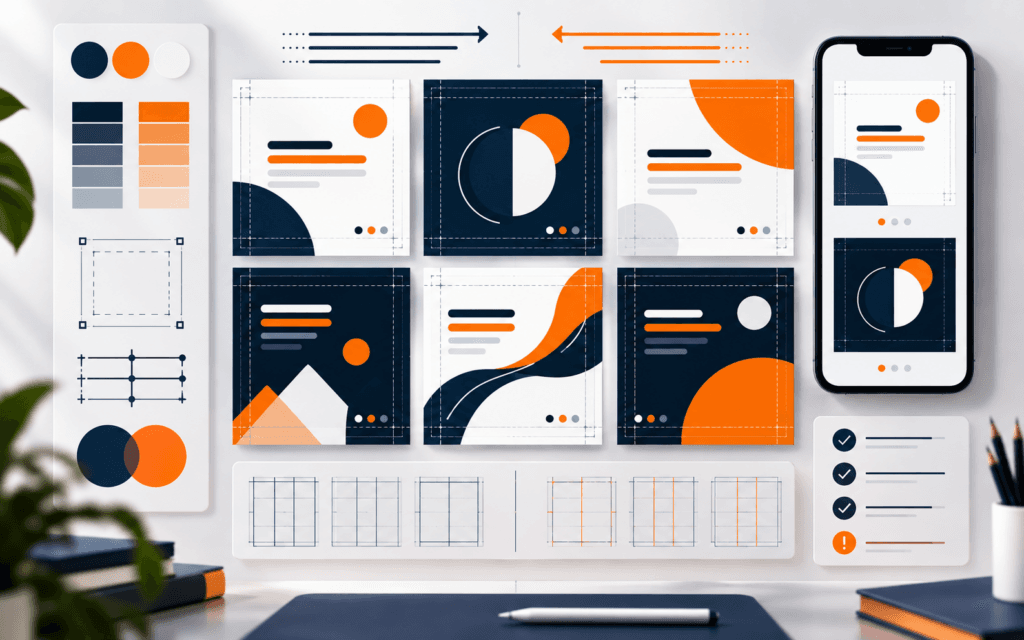
A strong Urdu-English carousel is one bilingual information system, not an English layout with Urdu pasted into spare space. Start with approved copy, assign a base direction to each text block, build a grid that can support right-to-left and left-to-right reading, define a compatible type pair, and test every slide at thumbnail and phone size before export.
The project ends with six coordinated slides, a content matrix, a reusable grid, documented type and numeral choices, safe-zone checks, and an export report. Those artifacts show design reasoning and production control more clearly than isolated mockups.
Use copy reviewed by a fluent Urdu reader. Do not present machine translation as approved language, reshape letters manually, or use decorative pseudo-script. Platform dimensions change, so record the dimensions and date used rather than calling one preset universal.
What You Need Before You Start
Choose a design tool that supports Urdu shaping and paragraph direction. Install licensed fonts only after confirming that every Urdu character, punctuation mark, numeral, and English glyph in the brief is available.
- Approved Urdu and English copy for six short slides
- A vector or layout tool with right-to-left text support
- Licensed fonts with complete required glyph coverage
- A phone for real-size review and a fluent Urdu reviewer
Keep these boundaries in place:
- No unreviewed automatic translation
- No text converted to outlines before language approval
- No single alignment rule forced on both scripts
- No promise that one export size covers every social platform
1. Turn the message into a bilingual content matrix
Action and reason: Place each slide goal, Urdu copy, English copy, call to action, evidence, and maximum line count in one row before opening the design tool. Copy length and information priority determine the layout, while late translation usually breaks hierarchy and spacing.
Inputs: The campaign goal, audience, approved source message, and six-slide sequence. Treat these inputs as the working boundary; adding an unreviewed dependency changes the task and should trigger a new check.
Expected output: A reviewed matrix in which both languages communicate the same intent without requiring identical word order. Keep the artifact with the project so another person can inspect the decision instead of relying on a finished screenshot.
Verification: Asking a fluent reviewer to compare meaning, tone, names, dates, numerals, and call-to-action wording. Record the input, expected result, observed result, and decision. A pass is credible only when another person can repeat the same check.
Failure condition: The Urdu is a literal machine translation or one language introduces a promise absent from the other. Correction: Return the affected row for language review and freeze copy only after both versions are approved. Repeat the original verification after the correction and retain the failed observation as part of the evidence trail.
2. Inventory scripts, punctuation, and numeral behavior
Action and reason: List mixed-direction elements such as Latin product names, URLs, phone numbers, dates, percentages, brackets, and punctuation. Bidirectional problems often appear at the boundary between scripts rather than inside a simple Urdu sentence.
Inputs: The approved content matrix and intended numeral style. Treat these inputs as the working boundary; adding an unreviewed dependency changes the task and should trigger a new check.
Expected output: A text-direction checklist for every mixed element. Keep the artifact with the project so another person can inspect the decision instead of relying on a finished screenshot.
Verification: Pasting each line into the chosen tool and checking logical order, visual order, punctuation placement, and numeral sequence. Record the input, expected result, observed result, and decision. A pass is credible only when another person can repeat the same check.
Failure condition: A phone number reverses, punctuation jumps sides, or a Latin name splits the Urdu sentence unexpectedly. Correction: Isolate the mixed run, set the paragraph base direction explicitly, and rewrite the line when the platform cannot preserve the intended order. Repeat the original verification after the correction and retain the failed observation as part of the evidence trail.
3. Build a directional grid instead of mirroring blindly
Action and reason: Create columns, margins, baseline rhythm, image zones, and separate RTL and LTR alignment anchors that share the same spatial system. A mirrored English template can place focal images, labels, and navigation cues in the wrong relationship to Urdu reading flow.
Inputs: The slide dimensions, content density, brand spacing, and focal-image direction. Treat these inputs as the working boundary; adding an unreviewed dependency changes the task and should trigger a new check.
Expected output: One master grid with documented RTL, LTR, and neutral zones. Keep the artifact with the project so another person can inspect the decision instead of relying on a finished screenshot.
Verification: Tracing the expected eye path on a printout or phone preview for both languages. Record the input, expected result, observed result, and decision. A pass is credible only when another person can repeat the same check.
Failure condition: The viewer must cross the slide repeatedly or the layout feels balanced only when one language is hidden. Correction: Reassign hierarchy and anchors while preserving common margins and rhythm rather than flipping every object. Repeat the original verification after the correction and retain the failed observation as part of the evidence trail.
4. Select and test the type system
Action and reason: Choose an Urdu family for shaping and readability plus an English family with compatible visual weight, then define display, heading, body, label, and numeral styles. Font personality matters, but incomplete glyph coverage, incompatible proportions, or weak small-size rendering can invalidate the system.
Inputs: Licensed font files, the full character inventory, and target phone size. Treat these inputs as the working boundary; adding an unreviewed dependency changes the task and should trigger a new check.
Expected output: A style sheet with family, weight, size, line height, alignment, and language assignment. Keep the artifact with the project so another person can inspect the decision instead of relying on a finished screenshot.
Verification: Rendering every required glyph, testing joins and diacritics, comparing apparent weight, and reading body text at actual phone size. Record the input, expected result, observed result, and decision. A pass is credible only when another person can repeat the same check.
Failure condition: Fallback glyphs appear, Urdu lines collide, or equal point sizes look unrelated. Correction: Replace the unsupported family or tune optical size and line height independently while keeping hierarchy roles consistent. Repeat the original verification after the correction and retain the failed observation as part of the evidence trail.
5. Compose the six-slide narrative
Action and reason: Assign slide one to the promise, slides two through five to one evidence or action each, and slide six to a clear next step, then compose both languages within the grid. A carousel succeeds through sequence and controlled disclosure, not six independent posters.
Inputs: The matrix, grid, type styles, brand colors, and approved imagery. Treat these inputs as the working boundary; adding an unreviewed dependency changes the task and should trigger a new check.
Expected output: Six slides with one dominant message each and consistent progress cues. Keep the artifact with the project so another person can inspect the decision instead of relying on a finished screenshot.
Verification: Viewing the slides in order without captions and asking a reviewer to state each slide purpose. Record the input, expected result, observed result, and decision. A pass is credible only when another person can repeat the same check.
Failure condition: Two slides repeat the same point, the first slide lacks a reason to continue, or the final action is ambiguous. Correction: Rewrite the sequence at matrix level, reduce competing elements, and rebuild only the affected slides. Repeat the original verification after the correction and retain the failed observation as part of the evidence trail.
6. Check accessibility and content integrity
Action and reason: Measure contrast, preserve meaningful text as text in the source file, add sufficient type size and spacing, and prepare a concise bilingual caption or accessible transcript. Visual polish does not compensate for unreadable contrast, tiny Urdu detail, or information available only inside an image.
Inputs: The final copy, brand palette, slide previews, and platform caption field. Treat these inputs as the working boundary; adding an unreviewed dependency changes the task and should trigger a new check.
Expected output: An accessibility review with corrected contrast and a text alternative. Keep the artifact with the project so another person can inspect the decision instead of relying on a finished screenshot.
Verification: Checking normal and large text contrast, grayscale hierarchy, zoom behavior, and comprehension with the fluent reviewer. Record the input, expected result, observed result, and decision. A pass is credible only when another person can repeat the same check.
Failure condition: Orange-on-white detail disappears, a screenshot is the only copy source, or meaning depends on color alone. Correction: Change the color pair, increase type and spacing, add labels or patterns, and publish the message in selectable caption text. Repeat the original verification after the correction and retain the failed observation as part of the evidence trail.
7. Run phone-size and thumbnail QA
Action and reason: Export a review set and inspect it in sequence at full phone width, feed thumbnail size, and a reduced screenshot overview. Desktop zoom can hide crowded lines, weak hierarchy, edge collisions, and inconsistent slide rhythm.
Inputs: Temporary PNG exports and a representative phone. Treat these inputs as the working boundary; adding an unreviewed dependency changes the task and should trigger a new check.
Expected output: A slide-by-slide QA sheet with pass, issue, correction, and retest columns. Keep the artifact with the project so another person can inspect the decision instead of relying on a finished screenshot.
Verification: Checking safe zones, reading order, line breaks, glyphs, contrast, image crops, slide numbers, and call-to-action clarity. Record the input, expected result, observed result, and decision. A pass is credible only when another person can repeat the same check.
Failure condition: A slide passes only when enlarged or a glyph changes in the raster export. Correction: Adjust source typography or crop, export again from the master file, and repeat the same viewing sizes. Repeat the original verification after the correction and retain the failed observation as part of the evidence trail.
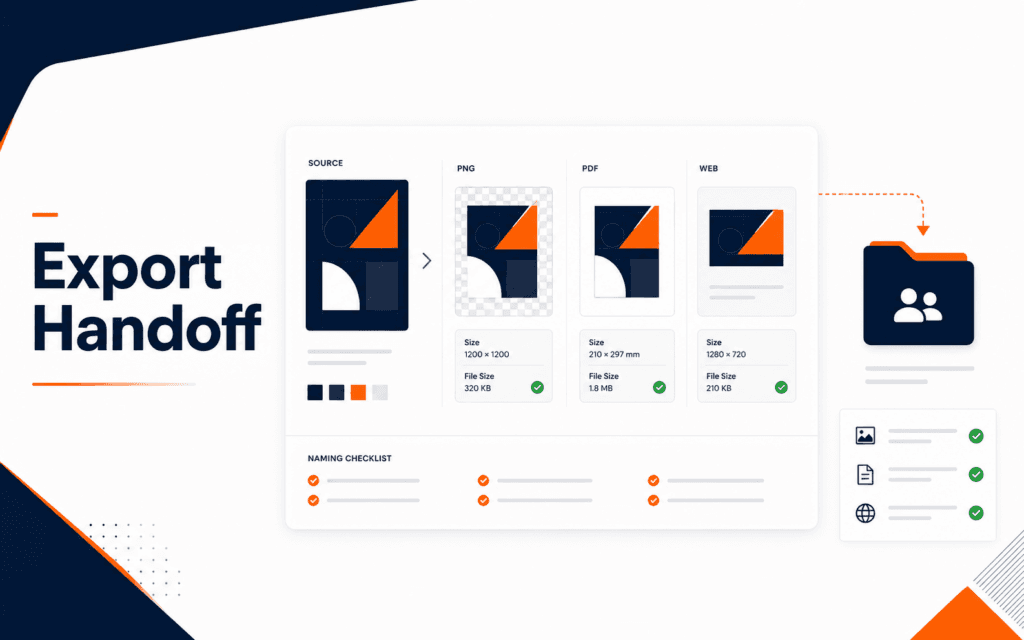
8. Package masters, exports, and handoff evidence
Action and reason: Save the editable master, linked assets, font-license notes, approved copy, final PNG files, preview sheet, and QA record with clear versions. A portfolio artifact should show a reproducible production system, not only compressed images detached from their source decisions.
Inputs: The approved source file, asset folder, export preset, and final review status. Treat these inputs as the working boundary; adding an unreviewed dependency changes the task and should trigger a new check.
Expected output: A handoff folder another designer can inspect and revise without missing dependencies. Keep the artifact with the project so another person can inspect the decision instead of relying on a finished screenshot.
Verification: Opening the package on a second machine where possible, checking dimensions and color mode, and comparing hashes or filenames with the approved set. Record the input, expected result, observed result, and decision. A pass is credible only when another person can repeat the same check.
Failure condition: Fonts are missing, copy differs from approval, exports use mixed dimensions, or the master cannot reproduce the final files. Correction: Relink assets, document dependencies, regenerate the complete set, and archive only the verified version. Repeat the original verification after the correction and retain the failed observation as part of the evidence trail.
Review the Evidence Before You Call It Complete
Run the work as a review, not as a presentation. Start with the promised outcome: Urdu and English copy is approved and meaning-aligned. Ask a second person to follow the documented inputs and checks without receiving a private explanation. Record where they cannot reproduce a result, where a decision lacks evidence, and where the artifact depends on hidden knowledge. Those gaps are part of the work and should be corrected before screenshots or portfolio copy are finalized.
Use the remaining acceptance criteria as release conditions: Mixed-direction text and numerals render in the intended order; Hierarchy remains clear at phone and thumbnail sizes; Every slide follows the shared grid without mechanical mirroring; The final package contains reproducible masters, exports, and QA evidence. A failed condition should identify the smallest upstream step that owns the defect. Correct that step, repeat the same check, and preserve the before-and-after result. This review discipline is what turns an exercise into credible evidence of skill without claiming client experience, production success, or testing that did not occur.
Completion Standard
The carousel is complete when both languages remain accurate and readable, the six slides form one coherent sequence, and the export set can be reproduced from the documented master file.
- Urdu and English copy is approved and meaning-aligned
- Mixed-direction text and numerals render in the intended order
- Hierarchy remains clear at phone and thumbnail sizes
- Every slide follows the shared grid without mechanical mirroring
- The final package contains reproducible masters, exports, and QA evidence
Graphic design learners in Gujrat, Punjab, Pakistan can use an Urdu-English carousel to practise a communication problem they may genuinely encounter, while the same evidence standards keep the project useful beyond one local brief.
When you want guided review of the complete workflow, the Graphic Design course provides a structured path from fundamentals to supervised project evidence. The article remains a self-contained method; the program is the next step for learners who need feedback, correction, and repeated practice.
Sources And Verification Notes
- Authoring HTML: Handling Right-to-left Scripts: Supports the concepts of RTL scripts, bidirectional text, embedded Latin runs, and explicit direction handling relevant to Urdu.
- Structural markup and right-to-left text in HTML: Supports assigning a base direction explicitly rather than inferring layout from language labels alone.
- Unicode Bidirectional Algorithm: Supports logical character order and the resolution of mixed-direction runs, neutrals, and numbers.
- Illustrator User Guide: Supports design-tool controls for right-to-left character direction, digit choices, and multi-artboard export workflows.
FAQ
Should Urdu and English use the same font size?
Not automatically. Match hierarchy and apparent weight, then adjust size and line height for each script so both remain readable and balanced at the final viewing size.
Can I mirror an English carousel for Urdu?
Mirroring can be a starting test, but imagery, mixed-direction text, numerals, and emphasis may need different placement. Preserve the grid system while composing the actual reading flow.
Should text be converted to outlines before delivery?
Keep an editable text master with licensed fonts and approved copy. Create outlined delivery variants only when the handoff requires them, because outlines make language corrections and accessibility work harder.
Want to Build Practical Technology Skills?
Explore RisingEdge courses designed to help students learn real skills, build projects, and prepare for career opportunities.