Plan a Full-Stack Student Project: Admissions Portal from Data Model to Deployment
A credible full-stack admissions portal is not a collection of disconnected screens. It is one controlled workflow: an applicant creates an account, chooses a program, submits one.

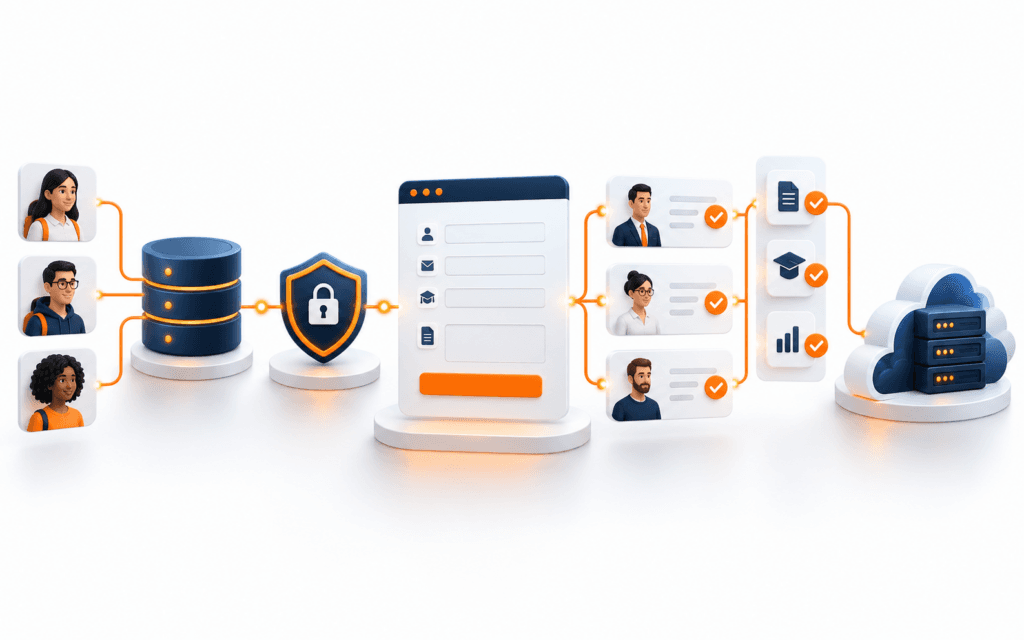
A credible full-stack admissions portal is not a collection of disconnected screens. It is one controlled workflow: an applicant creates an account, chooses a program, submits one application, and can read its status; an authorized reviewer can move that application only through approved states. Plan the data, permissions, contracts, tests, and deployment evidence before polishing the interface.
Following this guide produces a reviewable architecture pack and an implementation sequence. You will know which records exist, what each route accepts, who can perform each action, how errors appear, and what must pass on the production URL. That evidence is more useful in a student portfolio than a dashboard screenshot because another developer can inspect the reasoning and reproduce the checks.
This is a reference design, not a claim that the exact code has been deployed for a real admissions office. Use synthetic applicants and sample programs. Do not collect identity documents, payments, or sensitive personal data in a learning build. The project stops at a secure, testable application workflow.
What You Need Before You Start
Set up the smallest environment that can prove the workflow end to end. Use version control from the first commit and keep secrets outside the repository.
- Working HTML, CSS, JavaScript, React, and TypeScript fundamentals
- A Next.js App Router project with a relational database
- A local test account for an applicant and a separate reviewer
- A deployment target and documented environment-variable list
Keep these boundaries in place:
- No payment gateway, document OCR, biometric data, or production applicant records
- No multi-campus workflow, scholarship engine, or email automation until the core states are correct
- No authorization decision based only on a hidden button or client-supplied role
1. Write the workflow and invariants
Action and reason: Write one normal applicant journey and one reviewer journey before naming pages. A workflow exposes business rules that a screen list hides, including who owns an application and when it can change.
Inputs: A one-page brief containing applicant, program, application, reviewer, and status definitions. Treat these inputs as the working boundary; adding an unreviewed dependency changes the task and should trigger a new check.
Expected output: A numbered flow plus invariants such as one application per applicant and program, immutable ownership, and controlled status transitions. Keep the artifact with the project so another person can inspect the decision instead of relying on a finished screenshot.
Verification: Walking the flow with both roles and checking that every read and write has an owner. Record the input, expected result, observed result, and decision. A pass is credible only when another person can repeat the same check.
Failure condition: The brief uses vague verbs such as manage or process. Correction: Replace each vague verb with create, read, update, reject, or approve and name the actor and record. Repeat the original verification after the correction and retain the failed observation as part of the evidence trail.
2. Model the relational data
Action and reason: Define User, Program, Application, and StatusHistory records with stable identifiers and explicit relations. The database must prevent contradictory states instead of relying on interface conventions.
Inputs: The workflow invariants and an entity-relationship sketch. Treat these inputs as the working boundary; adding an unreviewed dependency changes the task and should trigger a new check.
Expected output: A schema with unique email, unique applicant-program application, foreign keys, timestamps, and status history. Keep the artifact with the project so another person can inspect the decision instead of relying on a finished screenshot.
Verification: Creating valid fixtures and deliberately attempting duplicate and orphan records. Record the input, expected result, observed result, and decision. A pass is credible only when another person can repeat the same check.
Failure condition: Status history can exist without an application or two applications can represent the same submission. Correction: Add the required relation and composite uniqueness rule, migrate a clean database, and repeat the fixture tests. Repeat the original verification after the correction and retain the failed observation as part of the evidence trail.
3. Define route contracts before components
Action and reason: Specify request, response, authentication, authorization, and error behavior for each route. A stable contract prevents forms and dashboards from depending on accidental server behavior.
Inputs: The data model and the minimal route list for programs, applications, and status updates. Treat these inputs as the working boundary; adding an unreviewed dependency changes the task and should trigger a new check.
Expected output: Contract notes for GET and POST application routes and the reviewer-only PATCH transition route. Keep the artifact with the project so another person can inspect the decision instead of relying on a finished screenshot.
Verification: Checking every field for type, required state, length, allowed values, and role permission. Record the input, expected result, observed result, and decision. A pass is credible only when another person can repeat the same check.
Failure condition: The client can submit ownerId, reviewer role, or arbitrary status text. Correction: Derive identity from the authenticated session, allowlist fields, and reject unsupported transitions on the server. Repeat the original verification after the correction and retain the failed observation as part of the evidence trail.
4. Implement server validation and authorization
Action and reason: Parse each payload once, validate syntax and business meaning, then authorize against the stored record. Valid data is not automatically authorized data, and client validation can be bypassed.
Inputs: The route contracts, session identity, allowed status-transition map, and maximum field lengths. Treat these inputs as the working boundary; adding an unreviewed dependency changes the task and should trigger a new check.
Expected output: Consistent success and error responses without secret details. Keep the artifact with the project so another person can inspect the decision instead of relying on a finished screenshot.
Verification: Sending missing, malformed, oversized, duplicate, unauthorized, and valid requests. Record the input, expected result, observed result, and decision. A pass is credible only when another person can repeat the same check.
Failure condition: A request passes because the form hid an option or supplied a trusted-looking identifier. Correction: Repeat validation and ownership checks inside the route before every database mutation. Repeat the original verification after the correction and retain the failed observation as part of the evidence trail.
5. Build the applicant flow around states
Action and reason: Create accessible program selection, application form, confirmation, and status views. The interface should reveal what the system knows without exposing reviewer controls.
Inputs: The accepted route contract, loading states, field errors, and an empty-state message. Treat these inputs as the working boundary; adding an unreviewed dependency changes the task and should trigger a new check.
Expected output: A keyboard-usable applicant flow that preserves input on recoverable errors. Keep the artifact with the project so another person can inspect the decision instead of relying on a finished screenshot.
Verification: Submitting valid and invalid cases at mobile and desktop widths with the applicant account. Record the input, expected result, observed result, and decision. A pass is credible only when another person can repeat the same check.
Failure condition: A failed submission clears the form or a status page leaks another applicant’s record. Correction: Separate field and server errors, retain safe input, and scope every query to the authenticated owner. Repeat the original verification after the correction and retain the failed observation as part of the evidence trail.
6. Build the reviewer flow with transition controls
Action and reason: Show reviewers a filtered queue, application detail, history, and only the next permitted actions. Review work needs traceability and must not permit arbitrary state edits.
Inputs: The transition map, reviewer role, application history, and optional decision note. Treat these inputs as the working boundary; adding an unreviewed dependency changes the task and should trigger a new check.
Expected output: A queue and detail view whose actions call the protected transition route. Keep the artifact with the project so another person can inspect the decision instead of relying on a finished screenshot.
Verification: Testing each permitted and forbidden transition with applicant and reviewer accounts. Record the input, expected result, observed result, and decision. A pass is credible only when another person can repeat the same check.
Failure condition: A reviewer can move rejected back to submitted or an applicant can call the PATCH route. Correction: Enforce the transition graph and role on the server, then add regression tests for both cases. Repeat the original verification after the correction and retain the failed observation as part of the evidence trail.
7. Create a risk-based test matrix
Action and reason: List tests by data rule, route, role, state transition, interface state, and failure path. Happy-path demos do not prove ownership, validation, or recovery.
Inputs: The invariants, contracts, two roles, and representative fixtures. Treat these inputs as the working boundary; adding an unreviewed dependency changes the task and should trigger a new check.
Expected output: Unit tests for rules, integration tests for routes, and browser smoke cases for the two journeys. Keep the artifact with the project so another person can inspect the decision instead of relying on a finished screenshot.
Verification: Running tests from a clean database and recording command, version, and result. Record the input, expected result, observed result, and decision. A pass is credible only when another person can repeat the same check.
Failure condition: Tests pass only when run after manual seed changes or in a particular order. Correction: Make fixtures deterministic, isolate state, and rerun the suite twice from a clean setup. Repeat the original verification after the correction and retain the failed observation as part of the evidence trail.
8. Deploy with migrations and secret controls
Action and reason: Prepare production environment variables, run the production build, apply reviewed migrations, and deploy. A local success does not prove that schema, secrets, and runtime settings are correct in production.
Inputs: An environment checklist, migration plan, seed policy, and rollback note. Treat these inputs as the working boundary; adding an unreviewed dependency changes the task and should trigger a new check.
Expected output: A deployed build containing no real credentials or sample reviewer password. Keep the artifact with the project so another person can inspect the decision instead of relying on a finished screenshot.
Verification: Checking build logs, migration state, HTTPS, authentication, and application creation on the public URL. Record the input, expected result, observed result, and decision. A pass is credible only when another person can repeat the same check.
Failure condition: The deployment uses a development database, missing secret, or unapplied migration. Correction: Stop traffic, correct environment ownership, apply the reviewed migration path, and repeat the smoke test. Repeat the original verification after the correction and retain the failed observation as part of the evidence trail.
9. Assemble portfolio evidence
Action and reason: Package the architecture diagram, contracts, test matrix, selected screenshots, deployment URL, and limitations. A reviewer needs evidence of decisions and verification, not a repository link without context.
Inputs: The final schema, route notes, test output, and redacted deployment checks. Treat these inputs as the working boundary; adding an unreviewed dependency changes the task and should trigger a new check.
Expected output: A concise case-study page that distinguishes implemented behavior from future ideas. Keep the artifact with the project so another person can inspect the decision instead of relying on a finished screenshot.
Verification: Asking another developer to reproduce the core flow from the README. Record the input, expected result, observed result, and decision. A pass is credible only when another person can repeat the same check.
Failure condition: The case study claims secure, complete, or production-ready without showing the relevant checks. Correction: Replace broad claims with the exact test, observed result, and remaining limitation. Repeat the original verification after the correction and retain the failed observation as part of the evidence trail.
Review the Evidence Before You Call It Complete
Run the work as a review, not as a presentation. Start with the promised outcome: One applicant cannot create duplicate applications for the same program. Ask a second person to follow the documented inputs and checks without receiving a private explanation. Record where they cannot reproduce a result, where a decision lacks evidence, and where the artifact depends on hidden knowledge. Those gaps are part of the work and should be corrected before screenshots or portfolio copy are finalized.
Use the remaining acceptance criteria as release conditions: Every mutation validates input and checks authenticated ownership or reviewer authorization; Forbidden status transitions fail without changing history; The production build and defined smoke tests pass on the deployed URL; The README lets another developer set up and verify the project without receiving credentials. A failed condition should identify the smallest upstream step that owns the defect. Correct that step, repeat the same check, and preserve the before-and-after result. This review discipline is what turns an exercise into credible evidence of skill without claiming client experience, production success, or testing that did not occur.
Completion Standard
The project is complete only when the same rules hold in the database, route layer, interface, tests, and deployed environment. Use these acceptance checks as a release gate.
- One applicant cannot create duplicate applications for the same program
- Every mutation validates input and checks authenticated ownership or reviewer authorization
- Forbidden status transitions fail without changing history
- The production build and defined smoke tests pass on the deployed URL
- The README lets another developer set up and verify the project without receiving credentials
For learners in Gujrat, Punjab, Pakistan, this project is a useful classroom review because the domain is familiar but the engineering standards are transferable. Local context should shape sample program names and user language, not weaken privacy, validation, or testing requirements.
When you want guided review of the complete workflow, the Full Stack Web Development course provides a structured path from fundamentals to supervised project evidence. The article remains a self-contained method; the program is the next step for learners who need feedback, correction, and repeated practice.
Sources And Verification Notes
- Next.js Route Handlers: Defines App Router request handlers, supported methods, and route conventions.
- Relational data modeling in Prisma ORM: Supports explicit models, primary keys, foreign keys, relations, and referential decisions.
- Input Validation Cheat Sheet: Supports syntax and semantic validation plus separate authorization controls.
FAQ
Which feature should I build first in an admissions portal?
Build one authenticated applicant creating one application for one seeded program. Add reviewer transitions only after ownership, uniqueness, and validation work. This vertical slice exposes data and contract problems earlier than building every page first.
Is a polished dashboard enough for a full-stack portfolio?
No. Include the data model, route contracts, authorization rules, negative tests, deployment checks, and limitations. Visual quality matters, but the evidence must show that the application protects data and behaves correctly.
Should a student use real applicant data?
No. Use synthetic names, emails, programs, and decisions. A learning project does not justify collecting identity documents or other sensitive records.
Want to Build Practical Technology Skills?
Explore RisingEdge courses designed to help students learn real skills, build projects, and prepare for career opportunities.