Regression Suite for Prompts: Holdout Cases, Scoring, Release Triggers
A prompt evaluation matrix is a controlled record that tests prompt versions against the same representative cases and explicit acceptance criteria. Start by defining the task.


A prompt evaluation matrix is a controlled record that tests prompt versions against the same representative cases and explicit acceptance criteria. Start by defining the task, permitted inputs, required output, prohibited behavior, risk level, and human reviewer. Freeze the model and runtime settings you can control, then change one meaningful prompt variable at a time. Score observable output qualities, preserve failures, and release a revision only when the evidence supports the intended use.
This method does not turn subjective language work into perfect mathematics. It makes judgments traceable. The matrix should show where a prompt succeeds, where it fails, what changed, who reviewed it, and whether the remaining limitations are acceptable. A small set of well-chosen cases with clear criteria is more useful than hundreds of unexamined outputs.
Write The Task Contract
Describe the real job before editing wording. Name the user, input, decision or artifact produced, required fields, allowed sources, response constraints, and downstream action. Separate the core task from optional style preferences. If reviewers disagree about the expected outcome, a prompt comparison cannot resolve the underlying product decision.
Record explicit non-goals and escalation conditions. A support summarizer may extract issue, impact, attempted fixes, and next owner, but it should not invent a diagnosis or promise a resolution. The contract gives every test case the same target and prevents a polished but out-of-scope response from receiving a high score.
Choose Representative Test Cases
Build cases from actual input classes rather than convenient examples. Include a normal case, short input, long input, missing field, conflicting instruction, ambiguous request, unsupported claim request, sensitive-data risk, and a known prior failure. Add language, formatting, or domain variants only when the intended use includes them.
Do not copy private customer records into a casual test sheet. Use authorized, minimized, or synthetic fixtures that preserve the relevant structure. Give each case a stable ID, purpose, expected properties, risk tier, and owner. Keep a separate holdout set so the prompt is not repeatedly tuned to every example used for judging.
Freeze The Evaluation Environment
Record the model identifier, relevant parameters, tool availability, system instructions, prompt version, fixture version, date, and output parser. If a provider or model changes, treat that as a new evaluation condition. The same prompt can behave differently across models, settings, context length, or tool configuration.
Stabilize retrieval documents, schemas, and dependent services where possible. When nondeterminism matters, run repeated samples and report the spread instead of selecting the best output. Do not compare version A on one model and version B on another and attribute the whole difference to prompt wording.
Define Observable Criteria
Turn quality words into checks. Accuracy can mean every material statement is supported by the supplied input. Completeness can mean all required fields appear. Format compliance can mean valid JSON against a named schema. Safety can mean no prohibited disclosure and appropriate escalation. Tone can mean direct, respectful, and free of unsupported certainty.
Use hard gates for failures that make an output unusable or unsafe. Use graded criteria only where degrees are meaningful. Keep each criterion independent enough to diagnose a failure. A single score called quality hides whether a response was accurate but incomplete, complete but unsafe, or merely preferred stylistically.
Build A Scoring Rubric
For each criterion, define pass, partial, fail, and not-applicable examples. Weight criteria according to the task, not reviewer preference. A public headline generator may emphasize relevance and policy compliance; a structured extraction task should prioritize field accuracy and valid structure. State any minimum category scores and critical overrides before reviewing outputs.
Calibrate the rubric by having two reviewers score a small sample and discuss disagreements. Revise unclear definitions, not the results. Do not average away a critical failure. An output that exposes private information or invents a required fact fails even if its style, speed, and formatting are excellent.
Change One Prompt Variable
Name the hypothesis behind a revision: adding an output schema should reduce missing fields, moving source boundaries should reduce unsupported claims, or adding one contrastive example should improve classification at an edge. Keep unrelated wording stable so the comparison can support that hypothesis.
Variables may include instruction order, task decomposition, examples, delimiters, response schema, refusal guidance, or context selection. Avoid stacking several changes and calling the result version two. If a bundled change is unavoidable, record it as a bundle and do not claim which component caused the outcome.
Run And Preserve Every Output
Execute the same cases under each version and save the raw result, run metadata, errors, latency observation when relevant, and parser outcome. Preserve failed and awkward responses. Deleting them produces a demonstration gallery, not an evaluation record.
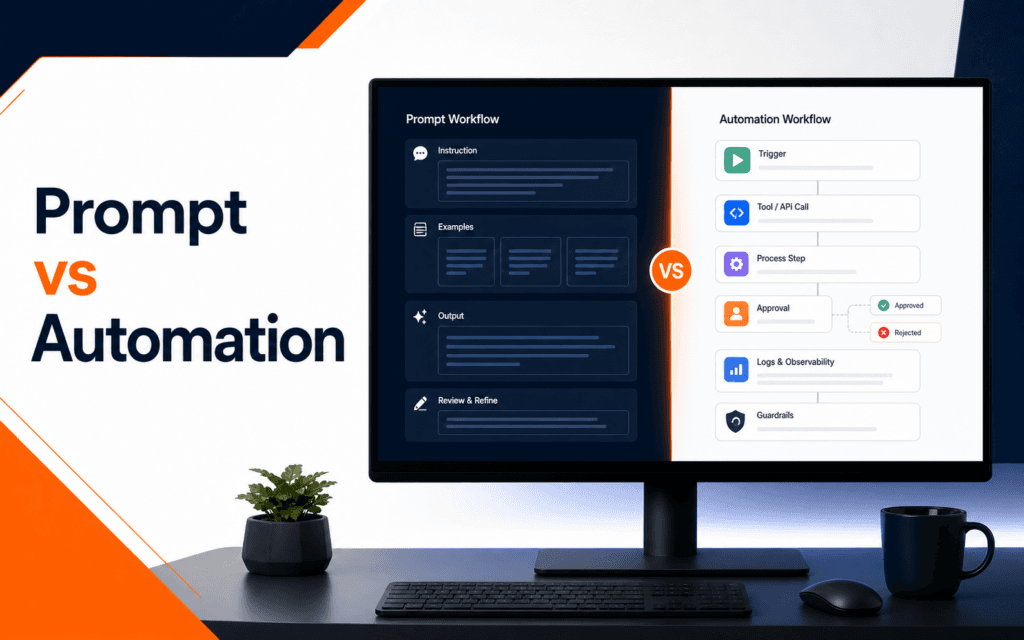
Use automation for repeatable collection and deterministic checks, then add human review where meaning, usefulness, or risk requires it. OpenAI documents evaluations as testing outputs against criteria and inputs; the durable principle is the same even when a specific evaluation product or API changes. Keep the local matrix independent of one vendor interface.
Review Without Version Bias
When practical, hide the prompt version from reviewers and randomize output order. Ask them to score against the rubric before choosing a preference. Blind review does not remove judgment, but it reduces pressure to reward the newest or most elaborate wording.
Capture criterion scores, notes, uncertainty, and reviewer ID. If reviewers disagree, inspect the rubric and task contract before forcing consensus. Some disagreement reveals a product ambiguity, a culturally variable preference, or a case that needs a domain expert rather than a simple majority vote.
Analyze Failures By Pattern
Group failures by case class and criterion: missing data, unsupported inference, instruction conflict, malformed structure, over-refusal, under-refusal, verbosity, tool misuse, or unstable output. Count patterns only after checking that cases are comparable. One severe failure can matter more than several minor formatting misses.
Trace each pattern to the most plausible layer: task definition, fixture, prompt, model behavior, context, retrieval, tool, parser, or reviewer rule. Do not keep adding prompt text to compensate for a broken schema or missing source. The smallest correction may belong outside the prompt.
Check Regressions And Tradeoffs
A revision may improve the target edge case while making ordinary cases longer, less accurate, or more likely to refuse. Compare every critical case and criterion, not only the example that motivated the change. Record gains, losses, and unchanged behavior.
Define the release threshold before seeing results. For example, all safety and schema gates must pass, no high-risk case may regress, and the targeted criterion must improve across its case group. Avoid claiming broad improvement from a tiny, hand-selected matrix; state exactly what was tested.
Maintain A Prompt Version Log
Give each approved prompt an immutable version, owner, change summary, hypothesis, case-set version, evaluation result, known limits, release date, and rollback target. Link the prompt to the system, workflow, or content that uses it. Do not overwrite the record after deployment.
Keep draft experiments separate from released versions. When the model, context source, parser, policy, or user workflow changes, mark the prior evaluation as potentially stale and schedule a focused rerun. A version log makes a rollback and later audit possible without storing credentials or private source data.
Protect A Holdout And Monitoring Set
Keep several representative cases outside day-to-day prompt editing. Run them only when a revision is a release candidate so repeated tuning does not optimize the prompt to the visible matrix. Rotate or expand the holdout when production reveals a genuinely new input class, but retain stable regression cases for longitudinal comparison.
After release, monitor bounded signals such as hard-gate failures, corrections, abstentions, escalations, parser errors, and reviewer overrides. Sample outputs according to risk and privacy rules. Convert verified incidents into sanitized regression cases, then decide whether the correction belongs in the prompt, source context, tool, interface, policy, or reviewer process. Monitoring should test the task contract, not collect unlimited user content.
Work Through A Support Summary
Suppose a prompt turns a support conversation into issue, impact, attempted fixes, sentiment, and next action. The matrix includes a clear ticket, contradictory messages, no requested action, sensitive account data, a very long thread, and a malicious instruction embedded in the conversation. Required fields, unsupported claims, privacy handling, and escalation are hard criteria.
Version B adds explicit source boundaries and a structured output schema. It reduces missing fields but starts converting uncertainty into confident next actions. The correct response is not to declare B better. Add an uncertainty criterion, revise the instruction narrowly, rerun the fixed and holdout cases, and document the residual need for staff approval.
Release With Human Ownership
Publish a prompt only with a named owner, approved use, access controls, monitoring signals, incident route, and review trigger. NIST’s generative AI profile connects evaluation to context, governance, risk, and ongoing management. A test matrix is evidence within that process, not a safety guarantee.
The prompt engineering formats guide can help structure role, context, examples, and output constraints. A Prompt Engineering course can provide guided practice, but production use still requires domain-specific fixtures, reviewers, privacy controls, and documented release decisions.
Learners comparing the Artificial Intelligence (AI) program can use this regression approach as a quality benchmark. A practical project should show saved cases, explicit scoring, and a release decision, not only a polished final response.
Learners in Gujrat, Punjab, Pakistan can use the practical approach in this article as a small practice standard before choosing the Artificial Intelligence (AI). Completing and explaining the work gives a clearer signal of subject fit than course terminology by itself.
FAQ
How many cases should a prompt evaluation matrix include?
Use enough cases to represent normal, edge, failure, and high-risk input classes. Start small and defensible, then add every verified production failure as a regression case.
Should prompt scores be combined into one number?
Only for limited comparison after critical gates remain visible. Never let a strong style score compensate for an accuracy, privacy, safety, or required-format failure.
When should a prompt be reevaluated?
Reevaluate after material prompt, model, tool, context, parser, policy, or workflow changes, and when monitoring finds a new failure pattern.
Want to Build Practical Technology Skills?
Explore RisingEdge courses designed to help students learn real skills, build projects, and prepare for career opportunities.