Prompt Engineering Formats: Compare Role, Context, Examples.
Prompt engineering formats help you choose how to instruct an AI model for a specific task. The practical comparison is this: use a role prompt to set perspective, context to.


Prompt engineering formats help you choose how to instruct an AI model for a specific task. The practical comparison is this: use a role prompt to set perspective, context to explain the situation, examples to show the pattern, constraints to prevent wrong outputs, and an evaluation step to check whether the answer is usable. Use this framework to diagnose and resolve the problem when prompts produce vague, inconsistent, or hard-to-use results.
OpenAI describes prompt engineering as writing effective instructions so a model can meet requirements more consistently. That means prompt quality is not about magic wording. It is about giving the model the right task, context, examples, boundaries, and success criteria.
Role Prompts Set Perspective
A role prompt tells the model what perspective to use. For example, act as a senior WordPress developer, act as an SEO editor, or act as a beginner-friendly Python tutor. A role can help when tone, domain judgment, or review style matters.
Role prompts are useful, but they are not enough. If you only say act as an expert, the model still does not know your audience, goal, source limits, or output format. The result may sound confident but miss the task.
Use role prompts when you need a specific lens. An SEO editor should think about intent, links, metadata, and readability. A coding assistant should think about constraints, edge cases, and tests. A career coach should think about practical steps and learner confidence.
For students, the mistake is treating the role as the whole prompt. A better format is: role, task, context, input, constraints, and output format. The Prompt Engineering course is directly relevant because learners need to practice choosing the right format, not memorizing one prompt.
Context Prompts Explain The Situation
Context tells the model what it is working with. It can include the audience, project goal, current problem, examples, brand tone, available tools, limitations, and what has already been tried. Without context, the model may answer the average version of the question instead of your version.
For a web project, context might include the framework, page purpose, target device, existing design system, and known bug. For content work, context might include reader level, search intent, required sources, and internal links. For automation, context might include inputs, outputs, failure conditions, and what must never happen.
Context should be relevant and compact. Too little context creates generic output. Too much unstructured context can bury the task. Place the most important constraints near the task instruction and separate long reference material clearly.
Microsoft’s prompt engineering guidance also treats prompt structure and context as part of the work. That supports a practical habit: write prompts as small specifications, not casual requests.
Example Prompts Show The Pattern
Examples are powerful when the output needs a specific style, structure, or level of detail. If you want three product descriptions, show one good product description. If you want a table with exact columns, show the columns. If you want a concise answer, show the target length.
Examples reduce ambiguity. A model may interpret short, professional, detailed, or beginner-friendly differently from you. A sample makes the expectation visible. This is especially useful for repeated workflows such as article outlines, QA notes, email drafts, code review summaries, or support responses.
Use examples carefully. A bad example teaches the wrong pattern. A private or copyrighted example may create legal or confidentiality problems. A very narrow example may cause the model to copy the structure too closely even when the new task needs variation.
The best examples are short, relevant, and labeled. Say this is the style to imitate, not the facts to reuse. Then provide the new input separately.
Constraint Prompts Prevent Common Failures
Constraints tell the model what not to do and what rules to follow. They can cover length, format, sources, tone, forbidden claims, safety rules, style rules, and output schema. Constraints are important when mistakes have a cost.
For example, a content prompt can say: do not invent statistics, do not mention unavailable course details, do not use emojis, do not promise rankings, and use only the supplied source list for factual claims. A coding prompt can say: do not change public APIs, do not add a dependency, and include tests for the changed behavior.
Constraints should be specific. Saying be accurate is weaker than saying cite only the supplied sources and mark unsupported claims for review. Saying make it clean is weaker than saying use H2 sections, short paragraphs, and no sales language.
Too many constraints can conflict. If you ask for a short answer, a complete tutorial, five examples, a table, and no lists, the model may fail because the instruction set is inconsistent. Review constraints before running the prompt.
Output Format Prompts Make Results Usable
A useful answer needs the right format. Sometimes you need a paragraph. Sometimes you need JSON, a checklist, a table, a code block, or a draft email. Tell the model exactly what shape to return.
Output format matters for work handoffs. A marketing manager may need a campaign table. A developer may need a patch explanation. A content editor may need headings and source notes. An automation workflow may need strict JSON.
When structure matters, provide a schema or labeled template. Ask for only that output. Then validate it. A model can still make formatting mistakes, so automated workflows should never assume the format is valid without checking.
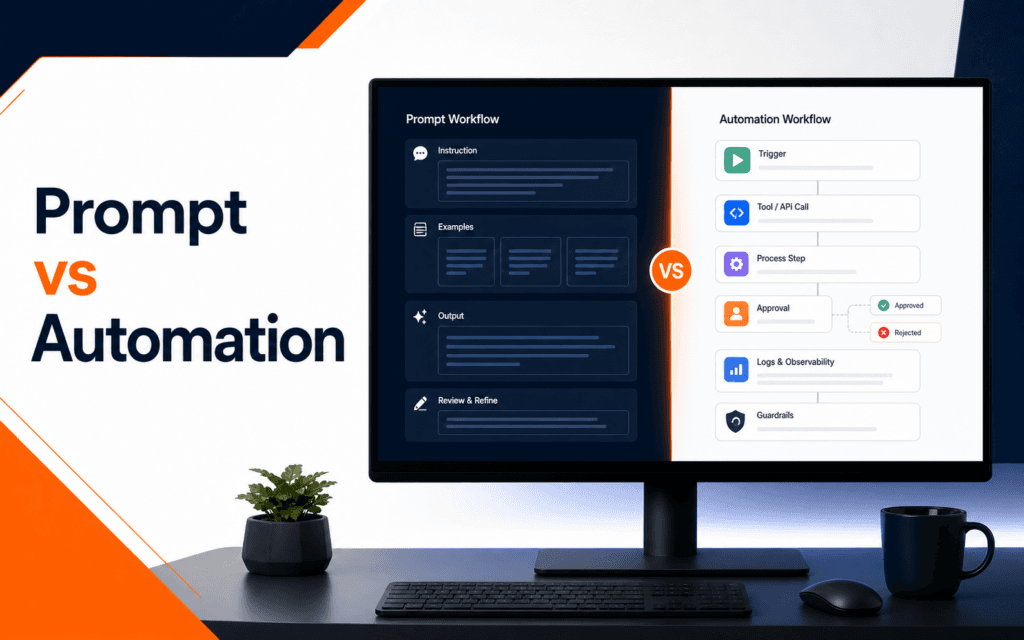
This is where prompt engineering connects with automation. The AI Automation and Agent Development course builds on the same idea: define inputs, outputs, checks, and failure handling.
Evaluation Prompts Improve The Second Draft
The first output should not always be the final output. An evaluation prompt asks the model or the human reviewer to compare the result against the requirements. This can catch missing sections, weak evidence, confusing structure, or unsupported claims.
A simple evaluation prompt is: check this answer against the brief, list missing requirements, identify unsupported claims, and suggest focused edits. For code, ask for edge cases and tests. For content, ask for reader usefulness, repetition, and source support.
Evaluation is stronger when the criteria are visible. If the criteria were vague, the review will also be vague. Use a checklist that matches the original task.
Do not let the model approve itself for high-risk work. Human review is still needed for factual accuracy, brand judgment, privacy, legal sensitivity, and final publishing decisions.
Which Prompt Format Should You Use?
Use a role prompt when the answer needs a specific perspective. Use context when the model lacks project knowledge. Use examples when the format or tone matters. Use constraints when mistakes are predictable. Use output formatting when the result must be pasted into another workflow. Use evaluation when the first answer needs quality control.
Most serious prompts combine several formats. A strong prompt might say: act as an SEO editor, review this beginner article, use the supplied checklist, do not rewrite the whole piece, return a table with issue, severity, evidence, and suggested fix. That prompt has role, context, constraints, format, and evaluation in one compact instruction.
The goal is not to write longer prompts. The goal is to write prompts that remove ambiguity and make review easier.
Final Checklist
Before using a prompt, check the task, role, context, examples, constraints, output format, and evaluation criteria. Remove conflicting instructions. Add source rules when facts matter. Ask for a small test output when the workflow is new. Save prompts that work, but keep improving them as the task changes.
Prompt engineering is practical communication. Better prompts make better first drafts, but good workflows still need testing, review, and revision.
For practice, take one real task and write it in three formats. First, write a role-and-task prompt. Second, add context and constraints. Third, add an example and a required output format. Compare the outputs side by side. The lesson becomes clear quickly: better structure usually produces answers that are easier to review, not just longer answers.
Keep a prompt notebook for recurring work. Save the task, prompt, output, edits needed, and final version. Do not save private client data or credentials. The point is to learn which formats work for content writing, code review, customer replies, planning, and analysis. A prompt notebook turns experimentation into a reusable skill.
For working professionals, the best habit is to treat prompts as versioned instructions. When a prompt improves, note what changed and why. Maybe the role became clearer, the output format became stricter, or the constraints removed unsupported claims. This helps teams reuse what works without pretending one prompt will fit every situation.
The Artificial Intelligence (AI) program is a relevant next step when you want to test these formats across practical tasks and learn when examples, constraints, or context improve reliability. Keep the comparison tied to outcomes, not prompt length.
This topic also has a local training use for students in Gujrat, Punjab, Pakistan: this comparison framework can be compared with practical exercises in the Artificial Intelligence (AI). Confirm current batch requirements directly and judge the learning path by inspectable work.
FAQ
What is the best prompt engineering format?
There is no single best format. The best format depends on the task. Role, context, examples, constraints, output format, and evaluation each solve a different problem.
Are examples always needed in prompts?
No. Examples help when style, format, or pattern matters. For simple factual tasks, clear instructions and context may be enough.
Why do prompts fail even when they are detailed?
Prompts fail when details are irrelevant, conflicting, incomplete, or unsupported by the input. A detailed prompt still needs clear priorities and review.
Want to Build Practical Technology Skills?
Explore RisingEdge courses designed to help students learn real skills, build projects, and prepare for career opportunities.