Handoff README for Web Projects: Setup, Test Evidence, Limits.
A technology portfolio case study should let a reviewer trace a project claim to evidence. Start with the brief, user, constraints, your role, and the condition before the work.


A technology portfolio case study should let a reviewer trace a project claim to evidence. Start with the brief, user, constraints, your role, and the condition before the work. Show the important decisions, implementation boundary, representative artifacts, testing method, failures corrected, remaining limitations, release or demonstration state, and handoff. Remove credentials, personal data, client-confidential material, and unsupported outcome claims before publishing.
The goal is not to reproduce the whole repository or narrate every day. It is to demonstrate judgment. A reviewer should understand what you were responsible for, why you chose one approach, how you checked the result, what changed because of evidence, and what another contributor would need to maintain or extend the work.
Write A Verifiable Project Brief
State the user, problem, requested outcome, delivery context, and definition of done in a short opening. Name whether the project was coursework, personal practice, freelance delivery, employment, or a team exercise. If the brief was hypothetical, say so. Do not present practice as a client engagement.
Include constraints that shaped decisions: time, existing stack, browser support, content readiness, data access, budget, team size, hosting, accessibility target, or integration limits. A constraint is useful only when the case study later shows how it affected scope or implementation.
Separate Your Contribution
List what you owned, what teammates or instructors provided, and what came from a framework, template, library, service, or generated assistance. For group work, connect your contribution to specific components, decisions, tests, documentation, or fixes. Avoid claiming the whole result because your name appears in the repository.
Explain review and approval boundaries. A developer may implement a registration form while admissions staff owns fields and policy, and an instructor may supply the design. Clear attribution increases credibility and helps a reviewer assess the skill the project actually demonstrates.
Create An Evidence Ledger
For every material case-study claim, record the artifact that supports it: issue, commit, pull request, decision note, screenshot, test result, performance trace, accessibility finding, deployment record, or handoff document. Store only authorized references and a short explanation of what each artifact proves.
Distinguish direct evidence from interpretation. A passing automated check proves that configured checks passed in that environment, not that every user can access the product. A screenshot proves one rendered state, not responsive behavior. The ledger prevents a polished narrative from expanding beyond its proof.
Choose A Small Artifact Set
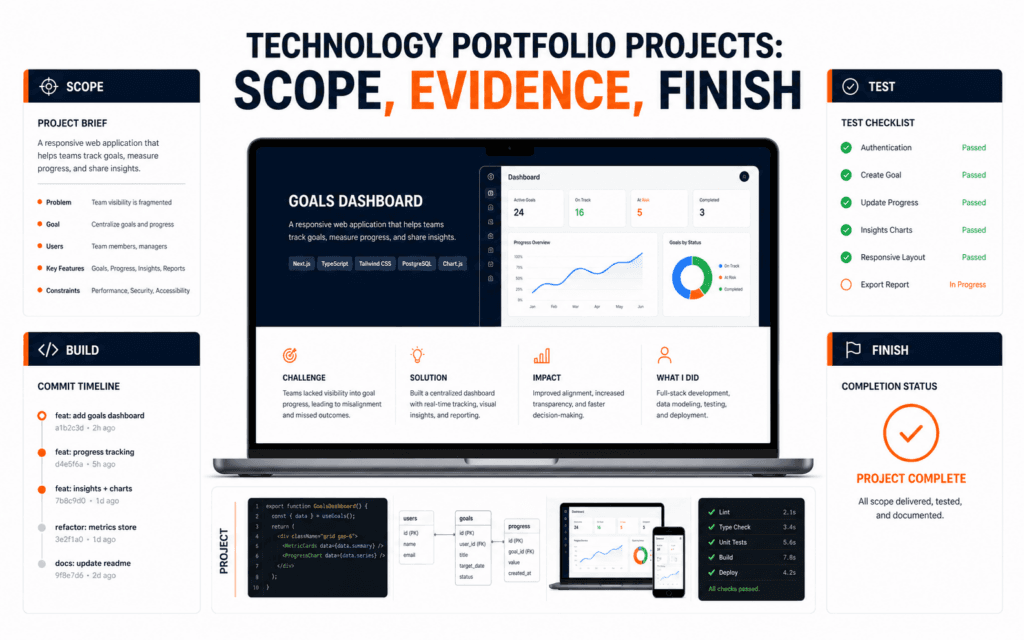
Select artifacts that reveal different parts of the work: the initial brief, one architecture or flow decision, one implementation example, one corrected failure, a QA record, and the final handoff or demonstration. Prefer readable excerpts and links over a wall of screenshots.
Sanitize before publishing. Remove tokens, environment values, private URLs, email addresses, student or customer records, internal comments, analytics identifiers, and licensed assets you cannot redistribute. Redaction should not leave enough surrounding detail to reconstruct sensitive information.
Explain Decisions As Tradeoffs
Use a consistent decision pattern: context, options considered, chosen option, reason, consequence, and trigger for reconsideration. For example, a static course catalog may be appropriate when content changes through code review, while a CMS might be deferred until ownership, access, preview, and migration needs justify it.
Do not invent rejected alternatives after the project. Use notes, issues, or commit history where possible. Admit when a choice was a course requirement or a learning experiment. Honest constraints show judgment more clearly than pretending every decision was an unrestricted production optimum.
Show Implementation At The Right Depth
Explain the system boundary and the few components central to the outcome. A full-stack case study might show route structure, data flow, validation, email delivery, error handling, and deployment configuration without pasting whole files. Link to a public repository only when its contents are safe and understandable.
Use code excerpts only when they demonstrate a decision or failure correction. Include language, framework, and version context where it affects interpretation. Do not claim code was production-ready merely because it ran locally; state the environments and scenarios actually verified.
Document A Failure And Correction
Choose one representative defect, not a theatrical catastrophe. Record the symptom, reproduction, affected layer, evidence collected, hypothesis, correction, regression check, and remaining risk. This shows debugging discipline and the ability to learn from evidence.
A Git bisect regression record is one example of reproducible evidence when behavior changed between known commits. Other projects may use a failing test, network trace, accessibility audit, or deployment log. Preserve the original failure rather than showing only the clean result.
Build A QA Matrix
Derive checks from the brief and risk. Include core user paths, validation, empty and error states, responsive layouts, keyboard access, content accuracy, security boundaries, integrations, and deployment behavior as relevant. Record environment, input class, expected result, actual result, evidence, owner, and status.
Separate automated, manual, and user evaluation. W3C notes that tools help identify accessibility issues but no tool alone can determine whether a site is accessible. State what was checked and what was not. Avoid badges that imply comprehensive quality without a defined test scope.
Report Results Without Inflating Them
Use measured values only when the method, environment, date, and baseline are available. A Lighthouse score, response time, completion rate, or defect count needs context and may not generalize. If the project had no real users or production traffic, do not invent conversion, engagement, or business impact.
Outcomes can still be concrete: completed the agreed flows, reduced a reproducible error, met the defined automated checks, passed a reviewed content inventory, or produced a deployable demonstration. Label estimates, observations, and instructor feedback separately from measured production results.
Design The Case Study For Reviewers
Lead with the project name, literal outcome, your role, and a compact visual of the real interface or system. Follow with brief, constraints, contribution, decisions, implementation evidence, QA, outcome, limitations, and links. Keep headings descriptive so a reviewer can scan quickly.
Use readable screenshots with useful captions and enough surrounding interface to understand the state. Provide alt text for informative images, strong contrast, semantic headings, keyboard-operable links, and responsive layout. Do not hide the only evidence inside an autoplay video or inaccessible carousel.
Connect GitHub Evidence Carefully
GitHub documents profiles and pinned repositories as ways to showcase selected work. Pin only projects that support the role you are seeking and give each repository a clear README with purpose, setup, status, architecture, testing, limitations, license, and contribution notes where appropriate.
Clean public history does not mean rewriting authorship or deleting evidence to look perfect. Remove secrets through an approved incident process, rotate exposed credentials, and document material history changes. Review dependencies, generated assets, and sample data before making a repository public.
Add Limitations And Next Work
Name what the project does not cover: real payment, production scale, user research, multilingual content, complete accessibility conformance, monitoring, offline behavior, or browser range. Link each limitation to a practical next evaluation or implementation step.
Limitations prevent reviewers from assuming that a demonstration proves more than it does. They also show prioritization. A good next step is specific and evidence-led, such as testing the registration flow with keyboard and screen-reader users, not a vague promise to make everything better.
Prepare A Handoff
Write how another contributor can run, configure, test, deploy, monitor, and roll back the project. Include prerequisites, safe environment setup, data fixtures, commands, ownership, known issues, dependency update policy, and recovery steps. Keep secrets outside the document.
Test the handoff by asking another person to use it in a clean environment where feasible. Record missing assumptions and correct the documentation. A project that only its author can operate is weak portfolio evidence for collaborative work, even if the interface looks polished.
Work Through A Course Registration Build
Suppose the project is a responsive course registration experience. The case study identifies learners and admissions staff, your ownership of the interface and server validation, staff ownership of fields and policy, SMTP as a dependency, and privacy limits. Evidence includes the approved field inventory, flow diagram, validation tests, mobile states, failure handling, and sanitized delivery log.
The outcome states that the verified demonstration accepts approved fields, rejects invalid input, preserves accessible error messages, and sends through the configured test environment. It does not claim enrollment automation, production security certification, or increased admissions. The handoff names environment variables, test data, deployment checks, and the staff owner for policy changes.
Publish A Focused Learning Narrative
End with what the evidence changed in your approach: reducing fields after privacy review, adding an error state after SMTP failure, changing component boundaries after repeated content, or expanding keyboard tests after an accessibility finding. Learning is strongest when tied to a documented decision.
A Full Stack Web Development course can provide structured practice across planning, frontend, backend, testing, and deployment. Your case study should still distinguish guided work from independent decisions and publish only evidence you have permission to share.
In Gujrat, Punjab, Pakistan, prospective learners can apply this workflow when discussing the Full Stack Web Development with an admissions adviser. Questions should stay tied to current exercises, review methods, prerequisites, and project evidence.
FAQ
How long should a technology portfolio case study be?
Use the shortest length that explains the brief, your role, key decisions, evidence, QA, outcome, limitations, and handoff. Depth should come from proof, not chronology.
Can I publish a private client project in my portfolio?
Only with appropriate permission and after removing confidential, personal, security-sensitive, and licensed material. When permission is absent, describe transferable skills without exposing project details.
Are screenshots enough to prove a project works?
No. Screenshots show selected visual states. Combine them with scoped tests, repository or change evidence, failure records, and a clear statement of the environments actually verified.
Want to Build Practical Technology Skills?
Explore RisingEdge courses designed to help students learn real skills, build projects, and prepare for career opportunities.