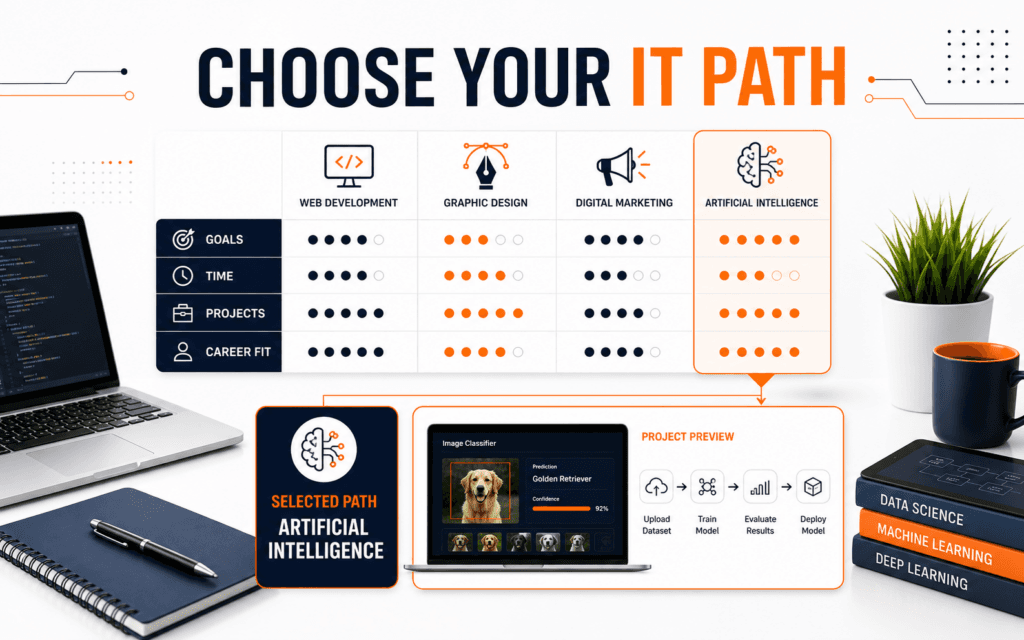
Technology Portfolio Projects: Scope, Evidence, Finish
The best technology portfolio project ideas are not necessarily the largest or most original. They are projects you can finish, explain, test, and present with clear evidence of.

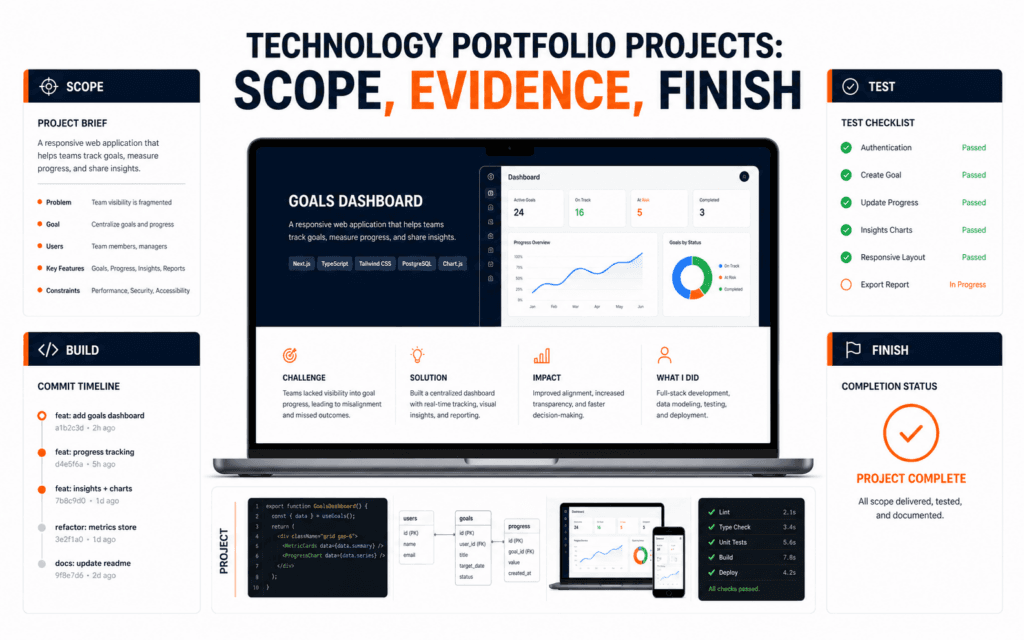
The best technology portfolio project ideas are not necessarily the largest or most original. They are projects you can finish, explain, test, and present with clear evidence of your decisions. A small working project with a strong case study usually communicates more ability than an ambitious idea left half complete.
Choose a project by scoring four things: scope, evidence, completion risk, and presentation value. Scope asks whether one person can build the defined version. Evidence asks what artifacts will prove the work. Completion risk identifies dependencies that may stall progress. Presentation value measures whether another person can understand the problem, process, and result without a long explanation.
Start With The Skill You Need To Prove
A portfolio project should answer a specific question about your ability. A web development project might prove that you can model data, build an interface, validate input, and deploy a working application. A graphic design project might prove research, hierarchy, typography, system thinking, and export quality. A marketing project might prove planning, measurement, analysis, and recommendations.
Write one evidence statement before choosing the idea: “This project will show that I can…” Complete the sentence with two to four observable skills. If the sentence becomes a list of fifteen technologies, the project is already too broad.
Students on a Full Stack Web Development course can use this approach to choose a project that connects front-end, back-end, database, and deployment skills without trying to reproduce an entire commercial platform.
Define A Small Complete Version
Describe the minimum complete version in one paragraph. State the user, the problem, the main workflow, the required data, and the final output. Exclude accounts, payments, real-time chat, complex permissions, and integrations unless one of those features is the skill you specifically need to demonstrate.
For example, a student expense tracker can be complete with transaction entry, categories, monthly summaries, editing, validation, and a deployed demo. It does not need bank synchronization, multi-currency accounting, team access, or financial predictions to become credible portfolio evidence.
A clear boundary makes planning honest. It also creates room for testing, documentation, accessibility, and polish, which are often the parts that distinguish a finished project from a tutorial exercise.
Use A Project Selection Scorecard
Score each idea from one to five for skill relevance, manageable scope, access to data or assets, testability, visual clarity, and completion confidence. Add a short reason beside every score. Do not select an idea only because its title sounds impressive.
Reject an idea if a critical dependency is outside your control. A project that requires a paid API, unavailable client content, sensitive customer data, or a teammate who has not committed can stop for reasons unrelated to your skill.
Prefer an idea with a clear user action and visible result. Reviewers can understand a booking flow, campaign report, responsive landing page, or image classification demo more quickly than a collection of disconnected technical experiments.
Plan The Evidence Before Building
Evidence should be designed into the project. Useful artifacts include a brief, requirements list, wireframes, data model, task board, version history, screenshots, test notes, accessibility checks, performance results, and a final reflection. Choose the artifacts that match the discipline instead of collecting everything.
For development work, commits and a readable repository show how the solution evolved. GitHub documents that a README commonly explains what a project does, why it is useful, how to start, where to get help, and who maintains it. Use that structure as a practical baseline, then add your problem, decisions, setup, features, limitations, and demo link.
For design work, show selected research, early directions, rejected choices, component or style decisions, and final applications. The Graphic Design course connects because a strong case study demonstrates process and communication, not only a polished final image.
Choose One Realistic User And Scenario
A project becomes easier to evaluate when it serves a defined user. Replace “everyone” with a specific person or team: a student tracking assignments, a small shop managing product inquiries, a local service business reviewing leads, or a content team organizing an editorial calendar.
Write one primary scenario from start to finish. A user opens the product, enters or finds information, makes a decision, receives feedback, and completes an outcome. That scenario becomes the basis for design, development, testing, screenshots, and demonstration.
Avoid inventing personal data or pretending a fictional project produced real business results. Label sample data clearly. If you report an outcome, distinguish a measured result from a design target or hypothetical estimate.
Separate Original Work From Tutorial Support
Tutorials can teach a technique, but a portfolio project should contain decisions that are yours. Change the problem, data model, interface structure, validation rules, content, or measurement plan. Be able to explain why your implementation differs from the learning example.
Keep a short learning log. Record the sources you consulted, the issue each source helped resolve, and the decision you made afterward. This is more credible than claiming that every line or concept was produced without help.
Do not hide the use of libraries, templates, AI tools, or starter code. Identify them, respect their licenses, and explain what you designed, changed, tested, and verified. Ownership means clarity about your contribution.
Select Projects For Development Paths
Good beginner development projects include a task workflow with filters, a small inventory dashboard, a course planner, an appointment request system, or a searchable resource directory. Each can demonstrate data structure, user input, state, errors, responsive behavior, and deployment.
A WordPress project might include a service site with custom content, editor-friendly blocks, forms, performance checks, and SEO settings. A learner following the WordPress Development course can document theme decisions, plugin choices, backups, and release checks.
Choose one technically meaningful difficulty, such as validation, filtering, authentication, or external data. Treat everything else conservatively so that the project reaches a finished state.
Select Projects For Design And Marketing Paths
A design portfolio project can solve a communication problem across a small system: a campaign identity, event materials, packaging concept, dashboard interface, or responsive website. Show hierarchy, layout, typography, color, accessibility, and consistent applications.
A marketing project can present a campaign brief, audience hypothesis, content plan, landing page critique, measurement model, and sample report. The Digital Marketing course is relevant because a portfolio should connect creative choices with channels, tracking, and decisions.
Never present simulated impressions, leads, or revenue as actual performance. If the project uses a hypothetical campaign, label the numbers as sample data and focus the case study on planning and analysis quality.
Select Projects For AI Paths
An AI project should demonstrate a useful workflow, evaluation, and limitations, not only a model call. Examples include document classification with a review queue, a retrieval assistant over a small verified knowledge base, or an automation that drafts a structured record for human approval.
Define what the system may do, what it must not do, what data it uses, and how output is checked. Include examples of successful and failed cases. The Artificial Intelligence course can support foundational understanding before a student adds AI to a portfolio project.
Keep human review visible when output affects customers, records, or decisions. Do not claim accuracy from a handful of examples. Describe the test set, evaluation criteria, known limitations, and next improvement.
Build In Milestones That Produce Evidence
Use milestones that end with inspectable artifacts. Milestone one can produce the brief and scope. Milestone two can produce a working core workflow. Milestone three can add error handling and responsive behavior. Milestone four can cover tests, documentation, and deployment.
Set a review rule for each milestone. The project moves forward only when the current output works and the evidence is saved. This prevents new features from hiding unresolved problems.
Keep a parking list for ideas outside the first version. A parking list protects focus without discarding useful future improvements. Select only one or two additions after the complete version is stable.
Test The Project Like A Reviewer
Open the project from a clean device or browser profile. Follow the main workflow without developer tools, local files, or hidden instructions. Check loading, navigation, forms, empty states, errors, keyboard use, mobile layout, and any public demo credentials.
Ask another person to explain what the project does after viewing it for one minute. If they cannot identify the user, problem, and outcome, improve the opening description and first screenshot before adding more features.
Record defects and resolutions. A short test table with scenario, expected result, actual result, and status shows disciplined work. Do not publish known security issues, exposed credentials, or private test data as portfolio evidence.
Package The Case Study
Use a clear sequence: problem, audience, role, constraints, process, decisions, result, testing, limitations, and next steps. Include only images that help explain a decision or outcome. Crop screenshots carefully and remove private information.
For code projects, provide a repository README, setup steps, technology choices, screenshots, live demo if safe, and known limitations. GitHub also allows users to pin selected repositories and gists so visitors can quickly find their best work. Curate the profile instead of expecting reviewers to search every repository.
For visual or marketing work, prepare a compact case study page or PDF with readable captions. Make sure the final assets remain understandable at normal viewing size and on mobile.
Finish Before Starting Another Project
Define done in writing: core workflow works, critical errors are handled, content is complete, mobile layout is reviewed, evidence is organized, documentation is current, and the case study is published. A project is not done merely because the main screen looks finished.
Allow a fixed polish period. Use it for consistency, accessibility, performance, spelling, screenshots, and deployment checks. Do not use polish time to reopen the scope with a major feature.
Once published, note the date and version. Collect feedback separately and schedule improvements. This preserves a finished artifact while showing that you can maintain work over time.
Use A Final Selection Checklist
Choose the idea only if you can name the skill it proves, describe the minimum version, access the required assets, test the main workflow, finish within the available time, and present the result clearly. If two of those answers are uncertain, reduce the scope or select another idea.
A credible portfolio grows through a small number of complete, varied projects. One project can show depth, a second can show a different problem, and a third can demonstrate collaboration or a more advanced constraint.
Compare the available Rising Edge technology courses when you need a structured learning path that leads toward practical project work. Choose the course based on the skills and evidence you want to build, not only the course title.
For a learner comparing classroom training in Gujrat, Punjab, Pakistan, the practical approach in this article turns interest in the Full Stack Web Development into concrete evaluation criteria. It clarifies which decisions and checks should appear in credible practical work.
FAQ
How many projects should a beginner portfolio include?
Start with two or three complete projects that show different skills or problems. Quality, clarity, and evidence matter more than a large count of unfinished repositories or screens.
Can a tutorial project go in a portfolio?
Yes, if you clearly credit the learning source and add meaningful original decisions, content, testing, documentation, or features. Be precise about what you changed and why.
What should every technology project case study contain?
Include the problem, user, your role, scope, process, key decisions, working result, test evidence, limitations, and next steps. Development projects should also include safe setup and repository documentation.
Want to Build Practical Technology Skills?
Explore RisingEdge courses designed to help students learn real skills, build projects, and prepare for career opportunities.