When Model-Written Code Fails: Create a Regression Proof
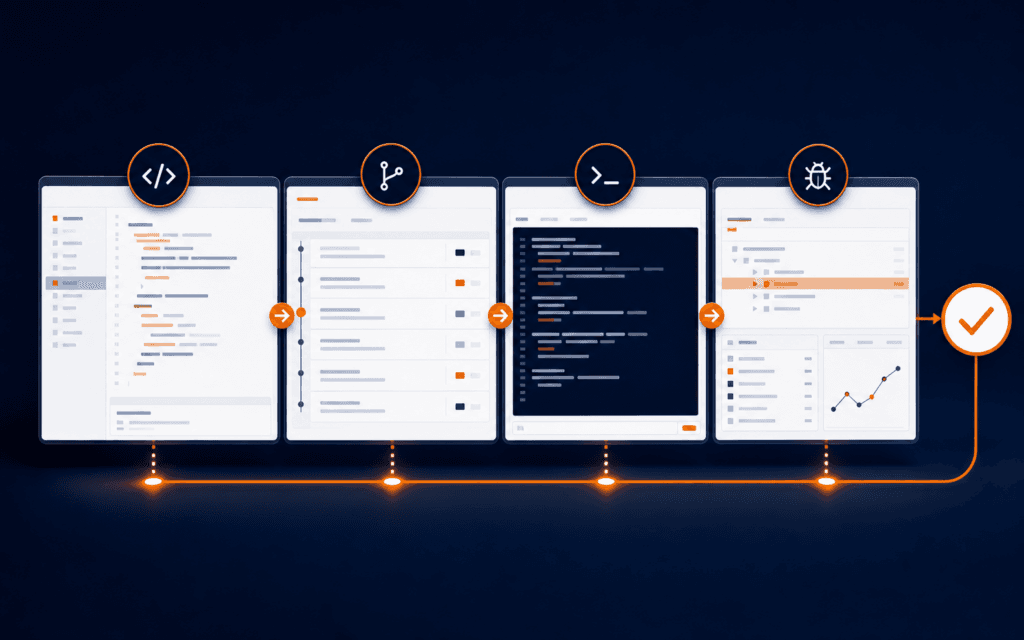
To debug AI-generated code, treat the output as an untrusted change proposal. Preserve the known baseline, reproduce one failure, encode the expected behavior in a test, isolate.

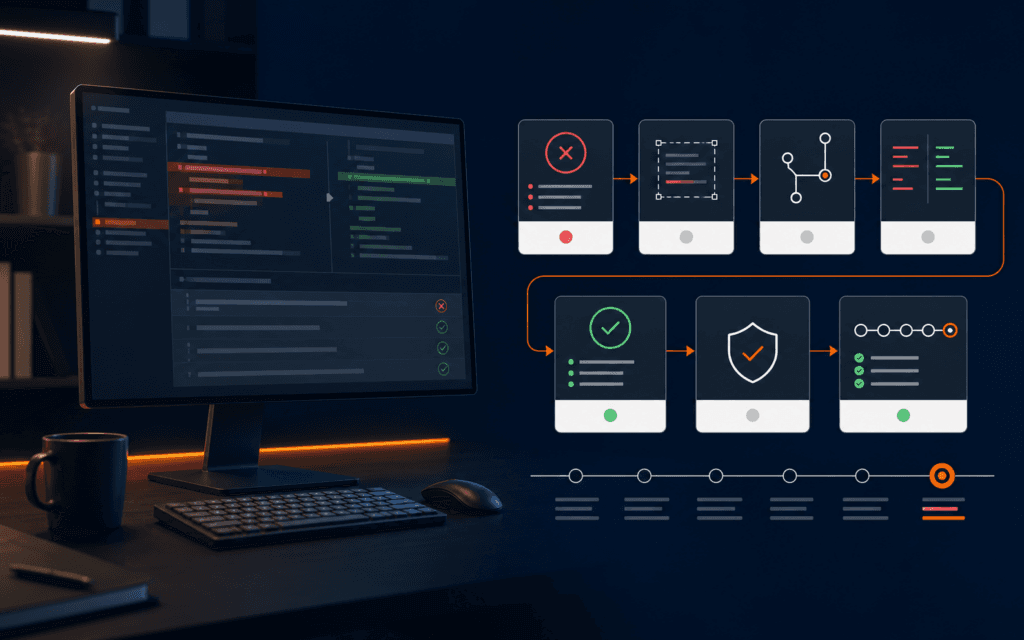
To debug AI-generated code, treat the output as an untrusted change proposal. Preserve the known baseline, reproduce one failure, encode the expected behavior in a test, isolate the work on a branch, make the smallest justified fix, and review the diff and regression evidence before merging. Repeated prompting without a stable failure case only changes uncertainty.
This workflow applies whether a model wrote a whole function, suggested a dependency upgrade, or changed configuration. Never send credentials, private source code, customer data, or restricted logs to an external model without authorization. Human maintainers remain responsible for requirements, security, licensing, tests, deployment, and the final integration decision.
Freeze The Failure Description
Write the observed behavior, expected behavior, exact input, environment, version, command, and smallest available error output. Separate what you observed from what you infer. A statement such as the API is broken is not reproducible; a named request returning a specific invalid status under a recorded setup gives the investigation a stable target.
Remove secrets and personal data from logs before sharing. Preserve the original failure artifact locally according to project policy. If the issue cannot be reproduced, add instrumentation or ask for more evidence rather than accepting a speculative patch. An intermittent failure needs frequency, timing, concurrency, and environment notes.
Return To A Known Baseline
Identify the last revision where the relevant test or workflow behaved as expected. Record the commit, dependency lockfile, runtime, configuration shape, and data fixture. Do not assume the default branch is healthy merely because it is current. Run the existing test suite and document pre-existing failures separately.
Use a clean working tree or a disposable authorized worktree so unrelated edits do not contaminate the comparison. Back up uncommitted user work before changing branches. Never use destructive reset commands against work you do not own. The goal is a trustworthy baseline, not an artificially clean report.
Create An Isolated Branch
GitHub explains that branches provide a contained area for features, fixes, and experiments. Create a focused branch from the verified baseline and name it for the issue. Keep model-generated experiments away from the protected or production branch until tests and review support the change.
Record the model, prompt context allowed by policy, generated suggestion, and human edits in appropriate development notes without committing sensitive prompts or credentials. Do not describe a generated patch as reviewed merely because it compiles. Isolation limits blast radius, but it does not make unsafe code acceptable.
Build A Minimal Reproduction
Remove unrelated framework layers, data, and UI until the smallest authorized example still fails. Keep the same input shape and important environmental condition. A minimal reproduction should run with documented commands and synthetic fixtures. If removing one dependency makes the failure disappear, that dependency relationship becomes useful evidence.
Avoid simplifying away the bug. Compare the reduced case with the original behavior and explain why it remains representative. Include expected output and actual output. Another developer should be able to clone or open the permitted package, run one setup sequence, and observe the same failure without your machine state.
Write The Failing Test First
Convert the expectation into a deterministic test before changing implementation. For Python, the official unittest documentation describes test cases, setup, assertions, suites, and command-line execution. Use the project’s established framework and style instead of adding a new test dependency for one defect.
Run the specific test and confirm it fails for the intended reason. A syntax error, missing fixture, or unrelated network timeout does not prove the bug. Then run nearby tests to understand existing behavior. Keep the test focused on observable contract rather than copying internal implementation details.
Inspect The Generated Change
Read every changed line and every affected call path. Check input validation, types, error handling, state mutation, concurrency, resource cleanup, authentication, authorization, data exposure, dependency behavior, and compatibility. Search for callers and tests. Generated code can be plausible while using a nonexistent API or overlooking a project invariant.
Verify imports and licenses, and consult official documentation for uncertain behavior. Do not execute unknown installation scripts or commands simply because the model suggested them. Review configuration and migration changes with extra care because a small diff can affect deployment, data, or secrets beyond the immediate function.
Ask For A Constrained Explanation
When using a model, provide the sanitized minimal reproduction, failing test, exact error, relevant interface, supported versions, and constraints. Ask for hypotheses and a minimal patch, not a wholesale rewrite. Require the response to distinguish verified facts from assumptions and to identify tests and risks.
Do not let the model choose product requirements. If several behaviors are reasonable, return to the issue owner or specification. A prompt can improve the quality of a proposal, but it cannot authorize a breaking change, new dependency, data migration, or weakened security control.
Make The Smallest Justified Patch
Change only what the evidence supports. Prefer correcting one boundary, condition, transformation, or cleanup path over replacing an entire module. Preserve public interfaces unless a reviewed requirement calls for change. Add comments only when the reason cannot be expressed clearly through code and tests.
Run formatting and static analysis with the repository’s existing tools. Inspect the diff for unrelated generated cleanup, renamed variables, deleted checks, broad exception handling, disabled tests, hard-coded values, or new network calls. Remove noise so reviewers can connect the patch directly to the failure and expected behavior.
Prove The Fix And Regression
Run the original failing test and confirm it now passes. Then run relevant unit, integration, type, lint, build, and security checks according to project policy. Test neighboring inputs, empty and maximum values, malformed data, repeated calls, failure paths, and authorization boundaries where applicable.
Record commands, versions, result summaries, and any tests that could not run. A green targeted test does not prove the entire system is safe, and a large suite does not guarantee the exact bug was exercised. Keep both the focused regression and broader compatibility evidence.
Create Reviewable Git History
GitHub’s code collaboration guidance describes branches and small meaningful commits as a way to isolate and review work. Commit the failing test separately when practical, then the fix and related documentation. Messages should explain behavior and reason, not merely state that AI fixed it.
Before pushing, scan staged changes for secrets, generated binaries, private logs, environment files, and unrelated work. Compare the branch with its intended base. Do not rewrite shared history or force push unless project policy and collaboration state make that explicitly safe.
Use A Pull Request As A Gate
GitHub documents that pull requests gather the description, commits, checks, files changed, discussion, and reviews around a proposed merge. Explain reproduction, root cause, patch, tests, risk, rollout, and rollback. Mark uncertainty and request the right domain or security reviewer.
Do not merge because the model or author expresses confidence. Require configured checks, approvals, and branch protections. Resolve comments with code or evidence, and rerun affected tests after changes. A draft pull request can expose the approach early without claiming that the patch is ready.
Document Root Cause And Limits
Write why the previous code failed, why the patch changes that behavior, what the regression test protects, and which related cases remain outside scope. Distinguish the model’s contribution from human diagnosis and review when your organization requires that record. Do not include sensitive prompt or repository content in public notes.
If the root cause remains uncertain, say so and avoid a confident permanent fix. A mitigation may reduce impact while further investigation continues. Define monitoring or follow-up evidence and an owner. Honest uncertainty supports safer maintenance than a tidy narrative unsupported by the failure data.
Build A Reusable Debugging Checklist
For future incidents, keep a checklist covering authorization, sanitized evidence, baseline, branch, minimal reproduction, failing test, official documentation, patch review, regression suite, secret scan, pull request, rollback, and follow-up. Adapt it to the language and deployment risk rather than treating every generated suggestion equally.
A structured Prompt Engineering course can help learners provide clearer context and constraints. The engineering standard still comes from reproducible behavior, project rules, tests, review, and accountable integration. Better prompting supports debugging; it does not replace it.
After deployment, verify the corrected user-visible behavior through approved monitoring or a bounded production check. Watch for related errors and rollback signals during the defined observation period. Close the issue only when the deployed revision, test evidence, monitoring result, and remaining limitations are linked in the project record. A locally passing branch is not evidence that release and configuration succeeded.
The Vibe Coding with AI program is a relevant setting for practising this evidence-first repair loop. Useful AI-assisted development training should require learners to reproduce failures, protect behavior with tests, and explain the accepted change.
Keep the regression test focused on observable behavior. Internal implementation may change during repair, but the saved input and expected result should explain exactly which user-facing failure must not return.
This topic also has a local training use for students in Gujrat, Punjab, Pakistan: the practical approach in this article can be compared with practical exercises in the Vibe Coding with AI. Confirm current batch requirements directly and judge the learning path by inspectable work.
FAQ
Should I run AI-generated code before reading it?
No. Inspect the code and suggested commands first, especially dependencies, scripts, migrations, network calls, and security controls. Use an isolated authorized environment.
What if I cannot reproduce the reported bug?
Collect more environment and input evidence or add safe instrumentation. Do not merge a speculative fix without a stable expectation and verification plan.
Is one passing regression test enough?
No. It proves a focused behavior only. Run relevant neighboring, integration, type, lint, build, and security checks and document any gaps.
Want to Build Practical Technology Skills?
Explore RisingEdge courses designed to help students learn real skills, build projects, and prepare for career opportunities.