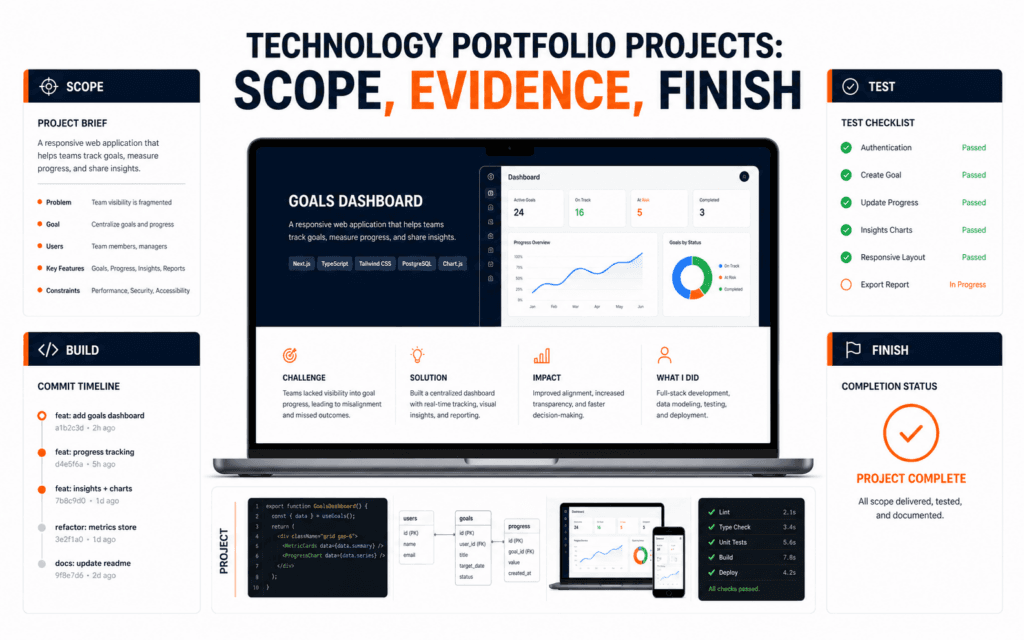
Prove Learning Transfer With One Adapted Technology Project
To turn course exercises into workplace skills, preserve the concept but change the context. Define a realistic user and outcome, replace sample assumptions with bounded.


To turn course exercises into workplace skills, preserve the concept but change the context. Define a realistic user and outcome, replace sample assumptions with bounded requirements, add failure cases, verify the result against acceptance criteria, and document decisions so another person can inspect or continue the work.
A course exercise is evidence of guided practice, not automatic proof of independent professional performance. The goal is not to disguise tutorial work as client work. It is to create an honest adaptation that shows what you understood, what you changed, how you tested it, and where the result still has limits.
Identify The Capability Behind The Exercise
Start by naming the behavior the exercise teaches. A store-product lesson may teach data modeling, template rendering, inventory states, and user feedback. A design lesson may teach hierarchy, constraints, and revision. A marketing lesson may teach audience segmentation and measurement. Tool names matter less than the sequence of decisions that produces a usable result.
Write the exercise as inputs, actions, outputs, and checks. Mark which decisions the instructions already made for you. If the tutorial supplied the data, layout, validation rules, and expected result, completing it proves that you followed a method. Your adaptation should take responsibility for a small number of those previously supplied decisions.
Choose A Realistic But Bounded Scenario
Select a scenario with a clear owner, user, and outcome that can be completed without pretending to serve a real client. For example, adapt a generic product page into a small catalog for a fictional training-equipment shop, or turn a sample dashboard into an attendance summary using synthetic data. State explicitly that the scenario is a learning project.
Keep the scope narrow enough to finish and verify. One complete workflow is stronger evidence than six unfinished features. Exclude payments, sensitive personal data, production integrations, legal claims, and security-critical behavior unless qualified supervision and a safe environment are part of the exercise. Record exclusions before implementation so ambition does not silently expand the project.
Replace Instructions With Requirements
Convert step-by-step directions into outcome-based requirements. Instead of ‘click this menu and add this field,’ write ‘an authorized editor can add a product with a name, price, image, and stock state, and visitors receive clear feedback when information is missing.’ Requirements let you choose an implementation while preserving a testable destination.
Prioritize requirements as required, useful, or future. Add acceptance criteria that another person can observe. Include normal behavior, invalid input, empty states, and recovery. This shift matters because workplace tasks rarely arrive as perfect tutorials; they contain ambiguity that must be clarified without inventing commitments on behalf of a stakeholder.
Change One Constraint At A Time
Adapt the exercise in controlled increments. First reproduce the baseline and save evidence that it works. Then change the dataset, user type, content structure, device constraint, or output format. Run the relevant checks after each change. When several variables change together, a failure becomes harder to locate and the evidence no longer shows which decision mattered.
Maintain a decision log with the requirement, options considered, chosen approach, reason, and verification. Keep entries brief and specific. A decision such as ‘use server-side validation because browser validation can be bypassed’ is more useful than ‘improved security.’ Do not claim production safety from a classroom project; identify what a real deployment would still require.
Use Representative And Ethical Data
Create synthetic or openly licensed data that exercises the workflow without exposing a person or organization. Include realistic variation: long names, missing optional fields, zero values, special characters, and boundary cases. Document the source or generation method and avoid copying confidential spreadsheets, customer records, private analytics, or copyrighted assets into a portfolio project.
Representative data helps reveal assumptions in interfaces, filters, exports, and reports. It does not make the project statistically representative of a market or population. State that limitation. When a lesson depends on real operational data, ask the instructor for a sanitized dataset and the permitted use before saving it outside the learning platform.
Verify Behavior With Acceptance Evidence
Create a small test table with requirement, setup, action, expected result, actual result, and evidence. Include at least one normal case, boundary case, invalid case, permission case where relevant, and restart or repeat case. A screenshot can show appearance, but logs, test output, exported files, and reproducible steps often provide stronger evidence of behavior.
Separate verification from demonstration. A polished video may explain the workflow while concealing an error path. Run the checks first, preserve results, and then record a concise walkthrough. If a test fails, document the defect and its impact instead of editing the evidence to imply success. Honest limitations show judgment and create a useful next task.
Document For The Next Person
Write a project overview that names the problem, user, scope, setup, workflow, decisions, verification, limitations, and next steps. GitHub’s official guidance on repository READMEs highlights explaining what a project does, why it is useful, how to start, and where to get help. Use that as a baseline, not as a substitute for project-specific evidence.
Make setup reproducible from a clean environment where practical. List versions and safe configuration, provide sample environment-variable names without secrets, and state the commands or actions that produce the verified result. Attribute the original course or tutorial and identify your modifications. Never present instructor assets, supplied code, or team work as entirely your own.
Request Review Against Decisions
Ask a reviewer to inspect a narrow set of artifacts: the requirements, one important implementation decision, the test evidence, and the documentation. Ask whether the outcome is clear, the evidence supports it, and any limitation is missing. Specific review prompts produce more actionable feedback than asking whether the whole project looks professional.
Record feedback, decide which change is in scope, and rerun affected checks. Do not apply every suggestion automatically because comments can conflict with the stated requirement or introduce new work. Explain accepted and declined changes respectfully. This review cycle is itself workplace evidence when it shows traceable reasoning rather than silent cosmetic revision.
Test The Handoff Without Coaching
Package the project as though another learner or teammate must continue it. Provide the permitted files, setup steps, sample configuration, requirement list, current status, known defects, and next action. Remove local paths, cached credentials, and assumptions that exist only on your computer. Then ask the reviewer to start from a clean location and follow the written path without a live explanation.
Observe where the handoff breaks. Missing versions, unexplained data, unclear commands, unowned decisions, and undocumented manual steps reveal that the workflow is not yet transferable. Fix the smallest causes and repeat the check. Independent handoff does not prove enterprise readiness, but it is stronger evidence than a demonstration that works only while the original author supplies missing context.
Add a short current-state note before review: what works, what is partially complete, what is intentionally excluded, which check last passed, and which artifact contains the latest evidence. This lets the reviewer distinguish a known limitation from a new regression. After feedback, update the note and archive obsolete evidence so the project does not contain several contradictory versions of the truth.
Present The Work Without Inflating It
Describe the project as an adapted learning exercise and distinguish provided elements from original decisions. Use verbs tied to evidence: defined, implemented, tested, documented, compared, or revised. Avoid claiming expertise, business impact, production scale, or client approval that the project did not establish. Link to permitted code, a live demonstration, or a concise case study.
O*NET’s web developer occupational profile describes work that involves needs, implementation, testing, problem resolution, and technical communication. A strong adaptation can demonstrate parts of that workflow, but one project does not prove every responsibility. Select evidence that makes the demonstrated capability easy to inspect.
Repeat The Transfer Cycle
After review, choose the next exercise based on a genuine gap rather than novelty. Repeat the pattern: identify the underlying capability, define a bounded scenario, write requirements, adapt one constraint at a time, verify, document, and review. Repetition across different contexts shows transfer more convincingly than collecting many near-identical tutorial outputs.
UNESCO’s technical education resources connect practical learning with changing technologies and workplace needs. A structured Shopify Development course may provide a useful guided context for commerce workflows. Whatever path you use, preserve honest attribution and let observable evidence support each skill claim.
Document the adaptation as a before-and-after decision log. Identify which tutorial assumptions no longer applied, what you changed, how you tested it, and which limitation remains; that evidence shows genuine transfer.
For learners in Gujrat, Punjab, Pakistan, the practical approach in this article provides a practical benchmark when exploring the Shopify Development. It helps prospective students ask about project work, feedback, and current requirements without relying on broad promotional claims.
FAQ
Can I include an adapted tutorial project in my portfolio?
Yes, when the course permits it. Credit the source, identify supplied elements, explain your original changes, and avoid publishing restricted code, assets, data, or answers.
How much should I change from the original exercise?
Change enough to own meaningful requirements and decisions, but keep the scope verifiable. One coherent new scenario with tested constraints is more useful than many cosmetic changes.
What evidence best shows workplace skill?
Use requirements, decision notes, reproducible setup, test results, selected artifacts, reviewer feedback, and an honest limitations section. Match each claim to something an evaluator can inspect.
Want to Build Practical Technology Skills?
Explore RisingEdge courses designed to help students learn real skills, build projects, and prepare for career opportunities.