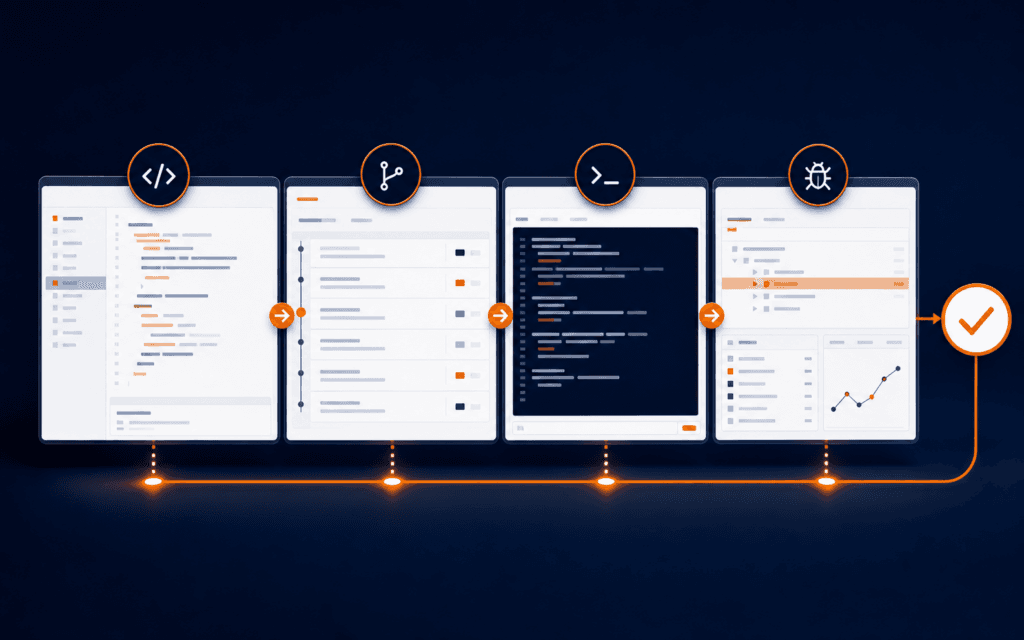
API Testing Workspace: Requests, Environments, Assertions, Handoff
An API testing workspace should let another authorized developer select a safe environment, run a bounded request sequence, see meaningful pass or fail evidence, and understand how.

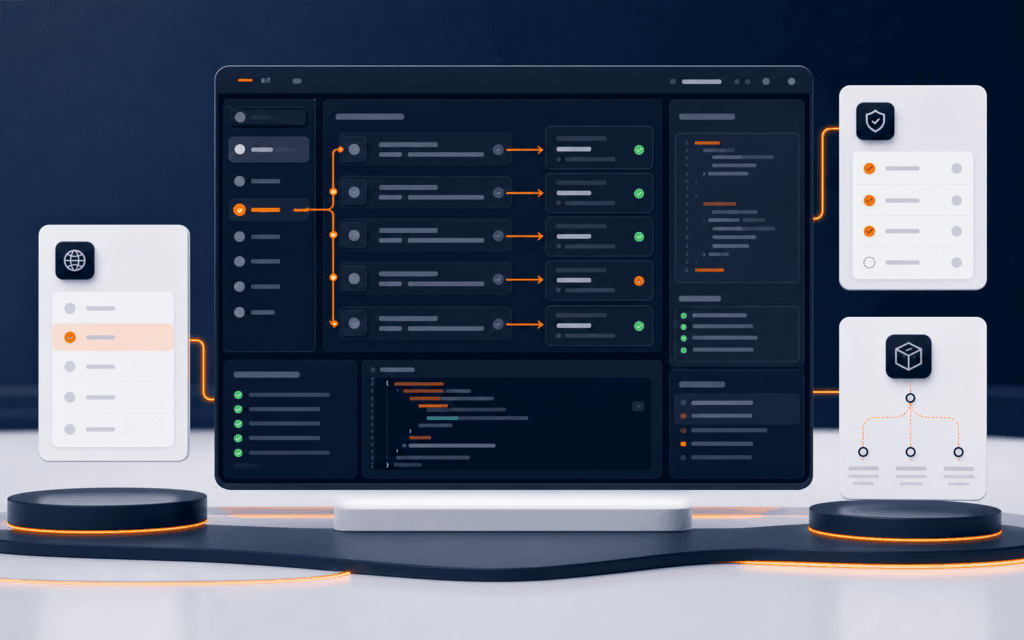
An API testing workspace should let another authorized developer select a safe environment, run a bounded request sequence, see meaningful pass or fail evidence, and understand how to troubleshoot it. Organize requests by workflow, separate configuration from secrets, assert contracts and important behavior, and document prerequisites, cleanup, and ownership.
A request returning a successful status once is not a test strategy. The workspace must distinguish expected success from authorization failures, invalid input, missing resources, conflicts, rate limits, and dependency problems. It should also make destructive operations obvious so a routine test cannot silently alter production data.
Define The Workspace Boundary
Name the API, owner, consumers, supported environments, authentication method, and workflows covered. List what the workspace does not test, such as load, penetration, browser behavior, payment settlement, or third-party reliability. This prevents a useful collection from being treated as proof of qualities it never measured.
Choose one representative workflow, such as create, retrieve, update, and archive a test resource. Identify prerequisites and cleanup. Mark each operation as read-only, creates test data, changes data, or destructive. Require explicit confirmation or a dedicated test environment for dangerous actions, and never use a production credential as a convenient default.
Use The API Contract As A Reference
Start with the current authoritative contract when one exists. The official OpenAPI Specification defines a language-agnostic interface description for HTTP APIs. A contract can describe operations, parameters, request bodies, responses, authentication, and schemas, but the workspace must still verify deployed behavior and business rules.
Record the contract version or source and note endpoints that intentionally differ. Do not silently edit generated requests until they no longer match the definition. If the contract is missing or stale, treat that as a visible risk and capture observed behavior carefully rather than presenting reverse-engineered assumptions as an approved interface.
Organize Requests Around User Workflows
Group requests in the order a developer or integration uses them, not only by HTTP method. Give each request a clear name that includes the outcome and important variation, such as create valid order, reject missing customer, or retrieve unknown order. Keep exploratory requests separate from the repeatable verification path.
Add concise descriptions covering purpose, prerequisites, input source, expected outcome, and side effects. Provide safe example bodies with synthetic values. When a response creates an identifier required later, capture it into an appropriately scoped variable and clear it during cleanup. Avoid manual copy-and-paste steps that make a run difficult to repeat or review.
Separate Environments From Secrets
Use variables for base URLs, tenant identifiers, test account names, timeouts, and other context that changes between environments. Postman’s official guidance explains that environments group variables for a work context and distinguishes local values from values shared with a team. Review the current tool behavior before sharing sensitive configuration.
Commit or share variable names and safe examples, not tokens, passwords, private keys, session cookies, or production identifiers. Obtain secrets through the approved secret manager or local provisioning process. Use least-privilege test accounts, rotate compromised credentials, and ensure logs, screenshots, exported collections, and failure messages do not reveal secret values.
Design Assertions That Explain Failure
Assert the status code, response media type, required structure, important value types, and the business outcome that matters to the workflow. Avoid checking an entire response byte for byte when timestamps, identifiers, ordering, or optional fields are expected to vary. Name each assertion so a failed run explains which expectation broke.
Postman documents using post-response scripts to test API response data and provides examples for parsing responses and making assertions. Keep scripts small and reusable. A passing status assertion does not prove that the correct record was created, the authorization boundary held, or the schema remained compatible.
Cover Failure And Boundary Cases
For every important success path, select the failure cases that protect the contract: missing required input, malformed values, unsupported values, duplicate operations, absent resources, expired authentication, insufficient permission, and unsafe state transitions. Include boundaries such as empty lists, maximum accepted lengths, zero values, and pagination edges when relevant.
Verify not only the error code but also the stable error structure and absence of unintended side effects. Do not assert internal stack traces or implementation details that clients should not depend on. If the API intentionally limits error detail for security, test the public contract while using authorized server logs separately for diagnosis.
Control Test Data And Cleanup
Give generated test records a recognizable prefix and a unique run identifier. Create the smallest data needed, preserve identifiers in run scope, and remove records when the environment and policy allow it. Cleanup should target only data created by the current test. A broad delete query is not an acceptable shortcut.
Make cleanup failures visible because abandoned data can affect later runs. When deletion is prohibited for audit reasons, document the retention behavior and use a dedicated namespace or account. Never test with real personal, financial, health, or customer data unless the environment, authorization, and handling procedure explicitly permit it.
Make Runs Reproducible
Define the request order, environment prerequisites, runner settings, expected duration, and success criteria. Pin important tool or schema versions where practical. Run the collection from a clean local configuration and through the supported command-line or continuous-integration path if automation is part of the intended use.
Capture a run summary with environment name, contract version, collection version, timestamp, test-account identity without secrets, counts of passes and failures, and links to authorized logs. A screenshot of green checks is insufficient when another person cannot identify what ran. Preserve failed evidence before changing the request or server.
Separate Exploration From Automated Gates
Interactive requests are useful while learning an endpoint, investigating a defect, or designing an assertion. Keep those experiments labeled and outside the stable run order. Promote a request into the repeatable suite only after its inputs, side effects, expected result, cleanup, and ownership are clear. Otherwise, a teammate may mistake temporary diagnostics for an approved test.
Automation should run a deterministic subset in an approved environment with provisioned secrets, bounded data, machine-readable results, and a failure policy. Do not place destructive requests in routine continuous integration. Decide whether a failed API check blocks deployment, creates an alert, or records diagnostic evidence, and assign an owner. A scheduled green run is useful only when failures are visible and acted upon.
Keep manual checks for behavior that requires judgment, temporary diagnostics, or controlled external coordination, and label them separately from automated assertions. Record who ran them, against which environment, and what evidence was reviewed. Revisit manual cases periodically: automate stable, frequent checks when the maintenance cost is justified, and retire checks that no longer protect a supported workflow.
Troubleshoot By Layer
When a request fails, first confirm the selected environment and resolved non-secret variables. Then inspect method, URL, headers, authentication, body, response status, response body, timing, and correlation identifier. Compare the result with the contract and a known-good request. Change one variable at a time so the diagnosis remains traceable.
Separate client setup, network access, gateway behavior, application logic, dependency state, and test assertion defects. A failing assertion may reveal a server regression, or it may contain an outdated expectation. Do not weaken an assertion merely to restore a green run. Decide whether the contract, implementation, or test is wrong and record the evidence.
Package A Safe Team Handoff
The handoff should include purpose, owner, scope, prerequisites, environment setup, secret-provisioning reference, run sequence, data policy, cleanup, expected evidence, troubleshooting, and known limitations. Export only approved workspace components and inspect the package for local values, tokens, cookies, private hostnames, and personal data before sharing it.
Ask a teammate to follow the documentation without verbal rescue. Observe where they cannot select an environment, obtain authorized access, understand a failure, or clean up data. Revise those points and run again. A guided Full Stack Web Development course can provide broader practice connecting API behavior with interfaces, data, testing, and deployment.
Maintain The Workspace As The API Changes
Review the workspace when the contract, authentication, gateway, data model, error format, or deployment topology changes. Remove obsolete requests, archive exploratory experiments, and update assertions with an explicit reason. Keep a short change log so consumers can match workspace behavior to API versions.
The final quality check is whether an authorized teammate can run the intended workflow safely and interpret every failure without guessing. If the workspace depends on hidden local state, shared production credentials, manual identifiers, or undocumented cleanup, it is not ready for handoff. Fix reproducibility before expanding endpoint coverage.
For a learner comparing classroom training in Gujrat, Punjab, Pakistan, this workflow turns interest in the Full Stack Web Development into concrete evaluation criteria. It clarifies which decisions and checks should appear in credible practical work.
FAQ
What should an API testing workspace include?
Include workflow-based requests, safe environment variables, secret-provisioning instructions, assertions, failure cases, test-data setup and cleanup, run evidence, ownership, troubleshooting, and limitations.
Should API keys be stored in a shared collection?
No. Share variable names and safe examples, then provision secret values through an approved local or secret-management process. Inspect exports and logs before sharing.
Is a successful HTTP status enough for an API test?
No. Verify the expected structure and business outcome, then cover important authorization, validation, missing-resource, boundary, and side-effect cases.
Want to Build Practical Technology Skills?
Explore RisingEdge courses designed to help students learn real skills, build projects, and prepare for career opportunities.