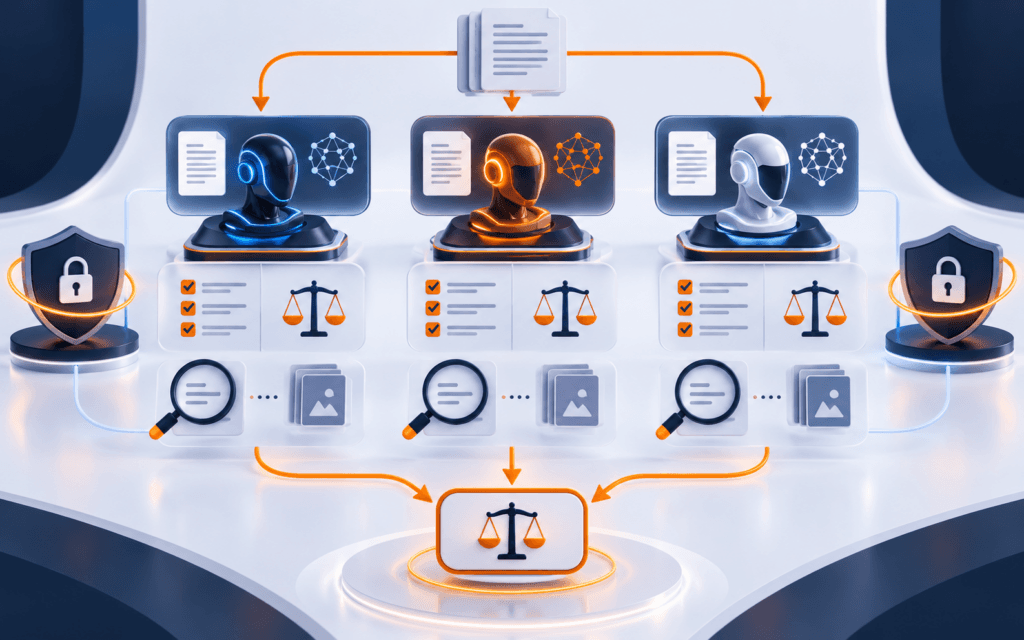
AI Project Problem Framing: Task, Data, Baseline, Risk, Human Review
AI project problem framing turns an idea such as use AI for admissions into a decision record that names the user, task, input, output, permitted data, baseline process, success.


AI project problem framing turns an idea such as use AI for admissions into a decision record that names the user, task, input, output, permitted data, baseline process, success criteria, failure cost, human reviewer, and stop conditions. Begin with the decision or work that needs improvement, not with a model. Compare the proposed workflow with a non-AI baseline and proceed only when the project has authorized data, measurable value, bounded risk, and clear ownership.
The first result should be a one-page frame another person can challenge. It is not a business case full of invented savings or a technical architecture selected in advance. It should make uncertainty visible and allow three legitimate decisions: proceed to a small evaluation, revise the problem, or stop because the task, data, benefit, or safeguards are not ready.
Name The User And Decision
Identify who experiences the problem, who performs the task, who receives the output, and who is affected by a wrong result. Describe the current decision in plain language. An instructor reviewing practice answers, a counsellor routing enquiries, and a developer classifying bug reports have different evidence and failure costs.
Avoid broad goals such as improve education or automate support. Write an observable task: classify each enquiry into an approved queue and show the evidence used, or suggest feedback that an instructor reviews before release. State whether the system advises, drafts, ranks, predicts, or acts. Those verbs imply different controls.
Describe The Current Workflow
Map the existing input, steps, tools, decision points, handoffs, delays, exceptions, and output. Record who fixes errors and what evidence already exists. Teams often discover that unclear forms, missing ownership, or an inconsistent policy causes more friction than the absence of AI.
Measure a small baseline with real process data where authorized: completion time range, rework frequency, unresolved cases, quality checks, or user complaints. Do not invent a percentage improvement to justify the project. If the baseline cannot be observed, the first project may be process instrumentation rather than model development.
Define The Smallest Useful Outcome
Choose one bounded outcome that a pilot can evaluate. For a course support assistant, that might be retrieving approved schedule and prerequisite information with links, not advising on every academic or financial question. Exclude decisions that require policy authority, identity verification, payment handling, or professional judgment until their owners are involved.
Write acceptance in user terms. The output should help the named person complete the task with less avoidable work while preserving accuracy, access, and recourse. A fluent response is not the outcome. The reader must be able to verify, correct, or escalate it appropriately.
Inventory Data And Permission
List every proposed input source, owner, purpose, sensitivity, collection basis, access rule, retention, quality limitation, and deletion route. Distinguish public course information, internal policy, staff notes, student records, and generated content. Availability does not equal permission to use data for a new AI purpose.
Minimize before collecting. Use synthetic or de-identified evaluation fixtures when they can represent the task. Do not place passwords, application secrets, identity documents, health information, or unapproved personal records into prompts or test logs. Escalate legal and policy questions to authorized specialists rather than treating a checklist as approval.
Check Whether The Data Represents The Task
Inspect coverage, missing values, outdated records, inconsistent labels, duplicates, and groups or situations that appear rarely. A routing model trained on historical staff choices may reproduce old queue mistakes. A content assistant supplied stale course pages may answer consistently and still be wrong.
Record what the data cannot establish. Small samples can support feasibility learning but not broad performance claims. Separate ground truth from convenient labels, and define who can adjudicate disagreements. If experts cannot agree on examples, the task definition or policy may need work before model selection.
Create A Non-AI Baseline
Compare the AI proposal with the simplest credible alternative: clearer instructions, a form with controlled options, search, templates, rules, a decision tree, staff training, or process ownership. The baseline must complete the same bounded task and use the same evaluation cases.
A baseline protects against technology bias. If a controlled form routes enquiries accurately and cheaply, a generative system may add cost and unpredictability without user value. AI is justified only when evidence shows that it improves an important dimension enough to offset its additional risk and operating burden.
Choose An Evaluation Plan
Define representative cases, expected outcomes, hard failures, graded criteria, reviewers, sample limits, and comparison method before building. Include ordinary work, ambiguous requests, missing information, conflicting evidence, unsupported action requests, sensitive data, and known exceptions. Keep a holdout set for the final pilot decision.
Measure task properties such as factual support, correct routing, completeness, abstention, correction effort, user comprehension, and time where relevant. Preserve raw failures and reviewer notes. An average score should never hide a high-impact error, and a demo should never substitute for repeated evaluation.
Map Harms And Affected People
Ask what happens when the system is wrong, unavailable, manipulated, overtrusted, or used beyond scope. Consider denial of access, misleading advice, privacy exposure, security abuse, unequal performance, reputational harm, and extra work transferred to staff or learners. Include people who do not directly operate the system.
Rate impact and likelihood with explicit assumptions, then define controls and residual risk. NIST’s AI RMF emphasizes governing, mapping, measuring, and managing risk in context. A generic responsible AI statement is not a control; named access rules, review gates, testing, logging, and incident ownership are.
Design Human Review Precisely
State what a person reviews, when, with what evidence, and with authority to correct, reject, or stop the workflow. Human in the loop is meaningless when the reviewer lacks time, context, training, or a usable interface. Show source material, uncertainty, and the system’s proposed action at the decision point.
Set review depth according to risk. Low-impact formatting suggestions may use sampling, while admissions eligibility, payment, or safety-related outputs may require complete authorized review or exclusion. Monitor automation bias: a person clicking approve on every output is not an effective safeguard.
Specify Security And Abuse Cases
Identify who can access the system, inputs, logs, tools, and outputs. Test prompt injection, unauthorized data requests, malicious files, excessive requests, tool misuse, and attempts to override policy. Separate user content from trusted instructions and restrict tools to the minimum required action.
Plan safe failure. If retrieval is unavailable, the system should not improvise a policy answer. If identity or permission is uncertain, it should stop or route the case. Keep security logs minimal and protected; logging every prompt can create a new sensitive-data store.
Estimate Operations, Not Just Build
List ongoing owners for source updates, evaluation fixtures, model or vendor changes, access reviews, incidents, corrections, user support, cost monitoring, and retirement. A proof of concept with no operating owner is not ready for production.
Estimate ranges and dependencies rather than invented certainty. Include review labor, data preparation, evaluation, integration, observability, security, and fallback operation. A lower model cost can be outweighed by correction effort or a higher-risk workflow. Record what evidence would change the estimate.
Write Go, Revise, And Stop Criteria
Proceed when the task is bounded, data use is authorized, the baseline is known, evaluation is feasible, controls match risk, and an accountable owner accepts the pilot. Revise when the outcome is useful but scope, data, rubric, or review design remains unclear. Stop when the task should not be automated, the data cannot be used, harm cannot be controlled, or a simpler process is better.
Make the decision reversible. Define pilot duration, user group, access boundary, success and failure thresholds, rollback, data cleanup, and review date. Do not let a pilot quietly become permanent because no one scheduled a decision.
Work Through An Admissions Assistant
An institute wants an assistant that answers course and admissions questions. The first frame limits it to approved public course descriptions, schedules, prerequisites, and contact routes. It cannot decide eligibility, quote unverified fees, collect identity documents, or promise admission. The baseline is improved site search plus a structured enquiry form.
Evaluation uses current authorized pages and cases for missing, conflicting, outdated, multilingual, and manipulative questions. Every answer must cite the supplied source or abstain. Counsellors review a pilot sample, corrections update the source and regression set, and the workflow stops if unsupported answers exceed the hard threshold. This is a testable project, not a claim that the whole admissions function is automated.
Turn The Frame Into A Learning Plan
Use the record to identify the skills actually needed: problem definition, data handling, evaluation, model behavior, interface design, security, and operations. The AI content source ledger provides a useful pattern for mapping changing claims to evidence and correction ownership.
An Artificial Intelligence course can provide structured foundations, but each production project still requires organization-specific permission, risk review, domain expertise, and evaluation. Keep the frame with the project so later contributors understand what the system was and was not approved to do.
For technology learners based in Gujrat, Punjab, Pakistan, this checklist shows one kind of evidence worth building through the Artificial Intelligence (AI). The focus should remain on defensible decisions and finished work rather than attendance or software familiarity.
FAQ
Should every AI idea start with a model comparison?
No. Start with the user task, current workflow, data permission, baseline, success criteria, and risk. Model comparison becomes useful only after the problem is testable.
What is a good non-AI baseline?
Use the simplest credible process that completes the same bounded task, such as clearer content, rules, search, templates, or a controlled form.
Does human review make an AI project safe?
Not by itself. Review must occur at the right decision, show enough evidence, give the reviewer real authority, and be supported by time, training, monitoring, and escalation.
Want to Build Practical Technology Skills?
Explore RisingEdge courses designed to help students learn real skills, build projects, and prepare for career opportunities.