AI Content Generation Workflow: Draft, Verify, Edit, Publish
An AI content generation workflow should not start with a blank prompt and end with an instant publish. A practical workflow has four stages: draft from a clear brief, verify every.

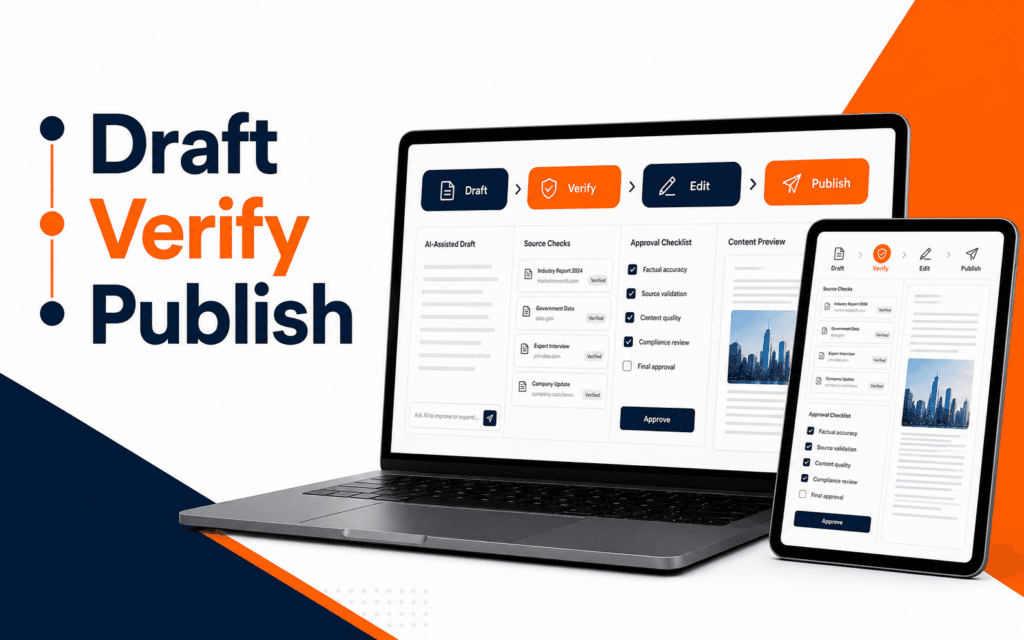
An AI content generation workflow should not start with a blank prompt and end with an instant publish. A practical workflow has four stages: draft from a clear brief, verify every factual claim, edit for the reader and brand, then publish only after a final checklist. That order lets beginners use AI for speed without handing judgment to the tool.
AI can help create outlines, rough drafts, summaries, examples, titles, and content variations. It can also produce confident mistakes, weak structure, repeated phrasing, and content that sounds polished but does not answer the reader well. The workflow matters because it separates generation from approval.
Start With A Content Brief
The best AI content starts before the prompt. A brief gives the model a job. It should name the audience, topic, purpose, format, required points, source limits, brand tone, and final action. Without that brief, the model has to guess, and those guesses often create generic work.
For example, a weak request says, write a blog post about AI content. A useful brief says the article is for beginners, should explain a responsible workflow, must avoid unsupported claims, should include a practical checklist, and should link naturally to a relevant course only when it helps. The difference is not cosmetic. The second request gives the output a direction that a human editor can judge.
Beginners should also decide what AI is allowed to do. It can draft a structure, suggest examples, or turn notes into clearer sections. It should not invent statistics, claim tool performance, create fake quotes, or decide that a piece is ready to publish. The human owns the final judgment.
OpenAI’s text generation documentation explains that models can generate many kinds of text from prompts, including structured formats. That flexibility is useful, but it also means the prompt needs constraints. If you need a content plan, ask for a plan. If you need a checklist, ask for checklist fields. If you need a draft, provide the approved facts first.
Generate Drafts In Small Passes
One long prompt that asks for everything often produces a draft that is difficult to evaluate. A better beginner workflow uses small passes. First, ask for an outline. Second, review the outline against the brief. Third, ask for one section or a full draft based only on the approved outline. Fourth, ask for a self-check against the brief.
Small passes make the work easier to control. If the outline is wrong, you can fix it before a full draft exists. If one section is thin, you can improve that section without rewriting the whole article. If the model starts drifting into unsupported claims, the issue appears early.
Structured output can help at this stage. OpenAI’s Structured Outputs guidance describes a way to make model responses follow a supplied JSON Schema. In content work, that idea is useful even outside code. A student can ask for fields such as target audience, search intent, section purpose, evidence needed, risks, and next action. A structured record is easier to review than a loose paragraph.
This does not mean every content task needs technical JSON. It means beginners should learn to request organized outputs. Clear structure helps editors see what is missing before prose makes the gaps harder to spot.
Verify Before Editing The Prose
Verification should happen before polishing. A beautiful sentence can still be wrong. If the article includes tool features, dates, prices, technical instructions, platform rules, medical claims, legal claims, or performance promises, those claims need source checks before the editor spends time improving style.
Use a simple claim log. Copy each factual claim into a table or checklist. Add the source URL, source type, access date, and confidence level. Mark claims as verified, needs rewrite, opinion, example, or remove. This sounds slow, but it prevents a common beginner mistake: improving a paragraph that should not exist.
Google’s people-first content guidance is useful here because it focuses attention on helpful, reliable content for people. AI can assist, but the article still needs original usefulness, clear expertise, and factual care. Google’s guidance about AI-generated content also states that using AI or automation appropriately is not inherently against its guidance when the content is helpful and people-first.
For Rising Edge students, this is where the AI Content Generation course becomes practical. The skill is not pressing a generate button. The skill is building a repeatable process that keeps usefulness, accuracy, and brand fit under human control.
Edit For The Reader, Not The Tool
After verification, edit the draft as a reader experience. Check the opening first. It should answer the main question quickly and tell the reader what they will be able to do. Remove generic introductions, vague claims, repeated definitions, and sentences that sound impressive but do not help.
Then review section order. A strong AI-assisted article usually moves from answer to method, then examples, limits, and next steps. If the draft starts with background history, move the practical answer higher. If the draft has ten shallow sections, merge them into fewer useful sections. If the FAQ repeats the body, either remove it or make it answer genuinely different questions.
Voice editing matters too. AI drafts often overuse balanced phrases, vague transitions, and repeated paragraph openings. Replace them with direct explanations. Use concrete nouns. Name the action. Explain the tradeoff. A simple sentence that helps the reader is better than a polished sentence that floats above the topic.
Internal links should be edited with the same discipline. Link only where the sentence naturally benefits. A section about responsible generation can point to the Artificial Intelligence course. A section about search visibility can mention the SEO course. Do not force a catalog of links into one article.
Build A Publish Checklist
The final publish checklist should be short enough to use every time. Confirm the article answers the intended reader problem. Confirm every factual claim is verified or clearly framed as advice. Confirm there are no placeholders, prompt notes, source tokens, fake numbers, or unsupported examples. Confirm headings are clear. Confirm internal links are natural. Confirm metadata summarizes the article honestly.
Also check originality. AI can produce content that feels familiar because it relies on common patterns. Add original structure through examples, decision rules, checklists, and the specific audience. The article should sound like it belongs to a real learning path, not like a general explanation anyone could generate.
Before publishing, read the article once on a phone. Many problems show up on mobile: long paragraphs, weak headings, crowded lists, and openings that take too long. If the article is hard to scan on a phone, improve the structure before publishing.
Use AI Where It Saves Real Time
AI is most useful in content work when the task is repetitive, structured, or blocked by a blank page. It can turn notes into a first outline, create headline variations, summarize a source, convert a transcript into sections, or produce a checklist from an approved process. These uses save time without pretending the tool understands the business goal by itself.
It is less useful when the task needs original judgment, local context, or final approval. A model can suggest a course page structure, but the institute still decides what the course actually includes. A model can propose a content angle, but an editor still decides whether that angle is distinct from existing posts. A model can rewrite a paragraph, but the team still owns the promise being made to readers.
This boundary keeps the workflow honest. Let AI accelerate repeatable drafting work. Keep human review for truth, usefulness, tone, brand fit, and publication decisions.
It also makes the workflow easier to teach and repeat. A student can show the brief, the generated draft, the verification notes, the edits, and the final checklist as separate evidence of skill. That record is more professional than a single finished article with no visible process behind it.
Practical Beginner Project
Choose one topic you understand. Write a short content brief. Ask AI for an outline only. Review the outline and remove weak sections. Provide three verified source notes. Ask for a draft using only those notes. Verify the draft. Edit the opening and section order. Add one useful internal link. Write a final checklist and publish only when every item passes.
This project teaches the real skill behind AI content generation. The value is not that AI writes faster. The value is that a trained person can turn rough generation into accurate, useful, reader-first content.
For learners in Gujrat, Punjab, Pakistan, this workflow provides a practical benchmark when exploring the Artificial Intelligence (AI). It helps prospective students ask about project work, feedback, and current requirements without relying on broad promotional claims.
FAQ
Can AI-written content rank in search?
AI-assisted content can be acceptable when it is helpful, reliable, people-first, and not created mainly to manipulate rankings. The final quality and usefulness matter more than the tool used to draft it.
What should beginners verify in AI content?
Verify facts, dates, tool features, prices, technical instructions, source claims, statistics, quotes, and any statement that could mislead the reader if wrong.
Should AI write the final article without editing?
No. AI can support drafting, but a human should verify claims, improve structure, remove generic language, check links, and approve the final version before publishing.
Want to Build Practical Technology Skills?
Explore RisingEdge courses designed to help students learn real skills, build projects, and prepare for career opportunities.