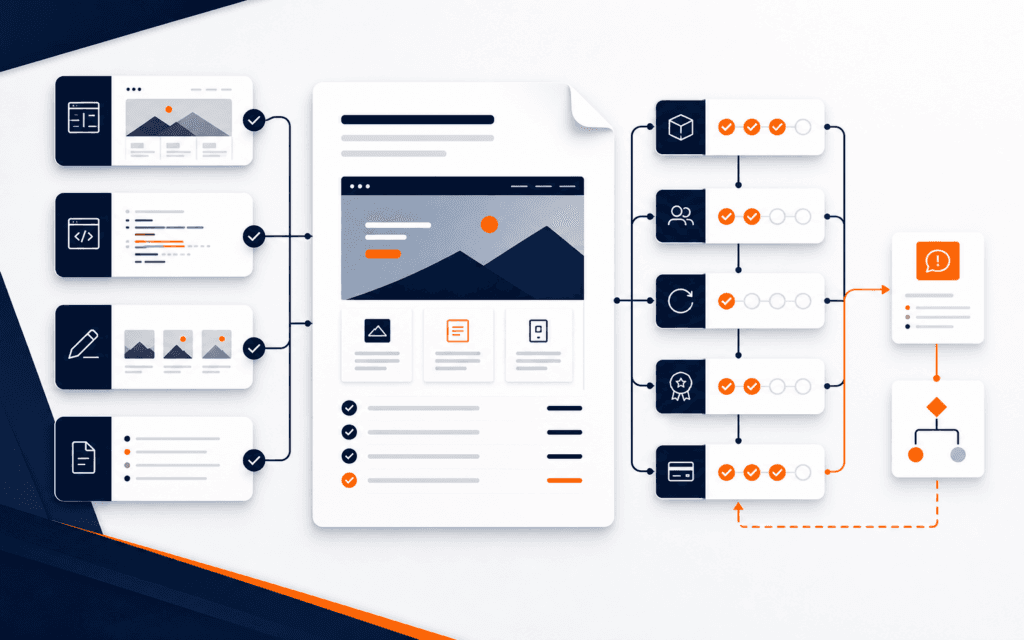
Client Discovery Record for Web Projects: Assumptions, Owners.
A freelance web design scope of work converts a sales conversation into a testable delivery agreement. To make a justified choice about what belongs in scope, record the business.


A freelance web design scope of work converts a sales conversation into a testable delivery agreement. To make a justified choice about what belongs in scope, record the business outcome, audiences, page or template inventory, content owner, technical environment, accessibility target, integrations, deliverables, review rounds, acceptance evidence, handoff package, exclusions, dependencies, schedule assumptions, and change process. A price without those boundaries is only an estimate attached to uncertainty.
This guide is operational, not legal advice. Local law, taxes, privacy duties, intellectual-property terms, and procurement rules require qualified review. Use discovery to expose uncertainty before committing. Keep the proposal readable, attach detailed specifications where needed, and make sure the signed agreement and scope use the same definitions.
Start With The Outcome, Not The Page Count
Ask what must change for the client or user when the project succeeds. A five-page brochure site, lead-generation site, course portal, and booking experience can have similar page counts but radically different research, content, integration, testing, and support needs. Write one primary outcome and the evidence that will indicate delivery, such as an approved responsive site with a functioning enquiry path and documented ownership.
Separate outcomes from performance promises you cannot control. A designer can commit to implementing approved analytics events, accessible interaction patterns, technical SEO basics, or a tested form. The designer should not guarantee rankings, revenue, traffic, or conversion results that depend on media spend, demand, sales follow-up, hosting, content, and external platforms.
Run Discovery Before Freezing Scope
Collect the current URL, brand assets, analytics access, audience evidence, competitors, required pages, content condition, domain and hosting ownership, forms, integrations, languages, legal notices, accessibility expectations, approval roles, launch date, and known constraints. Mark each item confirmed, assumed, missing, or client-owned. Missing information is a delivery risk, not a detail to hide inside a fixed price.
Use a paid discovery phase when uncertainty is material. Its deliverables might be a sitemap, content inventory, technical constraints, prototype, integration findings, risk register, and revised estimate. Discovery is not an unlimited strategy workshop. State its questions, outputs, duration, participants, and decision point so both parties know what happens next.
Define Deliverables As Inspectable Outputs
Name each output and its format: sitemap, wireframes, visual direction, reusable components, responsive page templates, configured CMS, migration batch, form, analytics setup, testing record, launch support, and handoff notes. Distinguish page templates from populated pages and custom components from ordinary content blocks. Clarify whether copywriting, photography, illustration, icon licensing, translation, or data entry is included.
For every deliverable, specify owner, inputs, review stage, completion condition, and file or environment. A phrase such as design the website is not inspectable. A stronger item identifies the approved desktop and mobile template states, supported breakpoints, supplied content, browser baseline, interaction behavior, and acceptance checklist.
Assign Client And Freelancer Responsibilities
The client may own timely content, factual approval, legal text, account access, stakeholder consolidation, and license purchases. The freelancer may own design files, implementation, testing within the stated environment, issue tracking, and handoff. Assign one client decision-maker and one delivery owner. Multiple uncoordinated reviewers create contradictory feedback and schedule drift.
State what happens when inputs arrive late or access is unavailable. Do not promise the original launch date while silently absorbing client delay. Use a documented pause, resequencing, or revised milestone. Protect credentials through approved password-sharing tools and least-privilege accounts; never place live secrets inside the scope document or ordinary email threads.
Set Technical And Accessibility Boundaries
Record the platform, theme or framework, hosting responsibility, environments, supported browsers, device classes, integrations, data migration limits, performance budget where measurable, backup ownership, and post-launch monitoring. Identify third-party services whose pricing, availability, consent behavior, or API limits remain outside the freelancer’s control.
W3C guidance treats accessibility as work that is planned, assigned, evaluated early, and monitored rather than checked only at launch. State the target standard or project policy, included components, content responsibilities, test method, remediation boundary, and acceptance evidence. Avoid claiming certification when the engagement only includes a limited review.
Control Revisions Through Decisions
A revision round should be one consolidated review against the approved brief, not an unlimited stream of preferences. Define the number of rounds per stage, feedback deadline, delivery format, decision-maker, and what counts as a correction versus a new direction. Fixing an implementation that does not match the approved design is not the same as requesting a redesigned approved component.
Keep a decision log with the item, requested change, reason, owner, date, effect, and resolution. If feedback changes the audience, sitemap, functionality, visual direction, content volume, or integration, assess it through change control. Do not start the change while cost, schedule, and dependencies remain ambiguous.
Write Acceptance Criteria Before Production
Acceptance criteria describe observable results. A registration form might require associated labels, clear required-field instructions, server-side validation, useful error messages, a success confirmation, authorized delivery, spam controls, privacy disclosure, mobile usability, and a retained test record. The related form UX checklist can help define evidence without prescribing a specific plugin.
Set review windows and a method for reporting defects. Classify launch blockers separately from minor follow-up items. Acceptance should not mean the client stopped replying, and it should not remain open forever. Define deemed acceptance only with appropriate professional or legal guidance and provide a practical sign-off record.
Separate Exclusions, Assumptions, And Dependencies
Exclusions say what is not provided, such as brand strategy, original copy, product photography, advanced SEO campaigns, custom CRM development, legal compliance advice, ongoing hosting, or unlimited content entry. Assumptions state what the estimate relies on, such as one language, supplied final copy, one payment provider, or an existing supported CMS. Dependencies identify outside events required for progress.
Do not use exclusions to contradict the sales promise. Surface them near the related deliverable and discuss high-impact items before signature. If a dependency could alter cost materially, price discovery first or use an allowance with a defined reconciliation method rather than presenting false certainty.
Plan Handoff, Launch, And Support
List the final repository or site transfer, design source files, exported assets, license record, content ownership, administrator roles, environment notes, backup, DNS responsibilities, analytics ownership, training session, known limitations, and test evidence. State whether the client receives working files, final exports, or both, and which third-party licenses cannot be transferred.
Define launch support as a time and issue boundary: for example, correction of reproducible defects against accepted scope during a named period. New content, new features, vendor changes, maintenance, security monitoring, and training for additional staff belong in a support agreement or change request. A relevant Web Design course can build the underlying design and handoff skills, but every client scope still needs project-specific evidence.
Use A Change Request When Scope Moves
A change request should capture the requested outcome, reason, affected deliverables, dependencies, cost, schedule, acceptance change, and authorization. Offer options when useful: replace an existing deliverable, extend the budget and schedule, or defer the request to a later phase. This makes tradeoffs explicit instead of framing every change as conflict.
Maintain the original scope and approved changes together as the current baseline. At each milestone, reconcile completed work, open inputs, accepted items, changes, risks, and next decisions. The goal is not paperwork volume. It is a shared record that lets both parties know what will be delivered, how it will be judged, and what happens when reality changes.
Work Through A Small Institute Website Scope
Suppose a training institute asks for a responsive site with course pages, admissions information, enquiry forms, and a launch in six weeks. Discovery shows that the logo exists, but course copy is incomplete, photography is unlicensed, admissions rules are changing, and no one owns SMTP or analytics. A responsible scope does not hide those gaps behind eight pages. It identifies four reusable templates, names the content fields and owners, limits migration to approved material, separates photography and copywriting, and makes email delivery and policy approval dependencies.
The proposal can offer two paths. A fixed implementation begins only after a paid content and technical discovery milestone closes the missing decisions. Alternatively, a phased engagement launches verified course and contact experiences first, then adds admissions automation after policy and integration approval. Both options preserve the outcome while exposing cost and schedule tradeoffs. The weaker option is promising every requested feature at one price and hoping inputs appear.
Price From Work, Risk, And Responsibility
Estimate research, information architecture, content handling, design states, component production, implementation, integration, review, testing, launch, project management, and handoff separately. Add explicit allowances only where their reconciliation is defined. Price is affected not just by visible pages but by decision complexity, stakeholder count, content readiness, platform constraints, accessibility evidence, data risk, and third-party behavior.
Do not convert uncertainty into unpaid contingency or an inflated unexplained number. Show assumptions and options. A lower-cost option may use approved platform patterns, client-supplied final content, fewer custom templates, and a later integration phase. A higher-cost option may include deeper discovery, copy support, custom components, migration, and broader testing. The client can then compare delivery models rather than choosing between arbitrary totals.
Run A Scope Read-Back Before Signature
Hold a short review in which the client explains the outcome, included deliverables, responsibilities, review process, exclusions, acceptance, handoff, and change route in their own words. Resolve mismatches in the document, not only in meeting notes. Confirm that links, appendices, pricing, milestones, and terminology refer to the same project version.
Finish with a pre-start checklist: agreement signed by authorized parties, deposit or purchase process complete, accounts and access method approved, decision-maker named, first inputs available, communication channel established, and discovery milestone scheduled. A scope that cannot guide kickoff, review, acceptance, and handoff is not finished, regardless of how polished the proposal looks.
For students in Gujrat and learners joining live online classes across Pakistan, the practical approach in this article offers a practical way to assess progress in the Web Design and Front-End Development. Compare programs by the work students can explain and improve, not by software lists alone.
FAQ
Is a proposal the same as a scope of work?
Not always. A proposal may explain approach and price, while the scope defines inspectable deliverables, responsibilities, acceptance, exclusions, and change control. Make their terms consistent.
How many revision rounds should a freelancer include?
Use the number the process genuinely needs and define a round as consolidated feedback against an approved brief. Additional direction changes should use change control.
Should accessibility be included in every web design scope?
Accessibility responsibilities and the intended level of review should be explicit. State the target, included components, content ownership, test method, and limitations rather than making a vague compliance promise.
Want to Build Practical Technology Skills?
Explore RisingEdge courses designed to help students learn real skills, build projects, and prepare for career opportunities.